Twilight – An illustration of the importance of music in movies

If Twilight had a decent score, it would have been a really good movie. Instead, it had a strange and irritating score that sounded like 25% Seattle grunge and 75% hokey, semi-atonal, new-age witches music. Plus it had weird and off-putting soundtrack of bizarre-sounding, spooky folk music. This is a love story, not a horror film! My wife said it best: “When you have your young lovers in a tree, you want the music to intensify the emotion of the situation, not distract from it.” Consider how the film starts to soar in the brief moments when Claire de Lune plays – this gives you a hint of what the film might have been had they paid attention to the score.

Even with the new-age witches music constantly intruding on everything, the film is still fun. Kristen Stewart is a marvel on screen – no one plays an awkward teenager like her. Combine Kristen Stewart with some good music and you’re half-way there (e.g. In the Land of Women.) The fellow playing Edward is pretty good, even if he appears to be channeling Bently Mitchum cir. 1993, for some reason. But what I did not expect is that the film is pretty well written. The set-up with the normal kids in school is really good, and it is interesting how this solid set-up actually stays with and enhances the movie all throughout. Supporting characters have a consistent place in the film, and are not summarily dropped after a while as they are in so many films of this ilk. The pacing of information is well done, and lots of information is conveyed through dialog. The dialog is kind of hard to listen to because both Edward and Bella talk in a haltering manner, but at least they made the effort to actually write dialog! They do have Kristen Stewart provide some narration, but the narration is minimal and pretty well done.

Many people were snarky about the vampires. I actually liked the super-stylish “Abercrombie & Fitch” vampires, and their cool house. I thought the CGI looked a little fake, but the good thing is that the movie did not rest on the CGI; it rests on dialog, as all good films do. Even the action part of the film at the end, when she is being hunted, is fun and engaging.

When this film came out last year, my wife and I arrogantly avoided it like the plague. We were like: “we want to see something GOOD, damn it!” So we saw everything but this movie – Bengamin Button, Slumdog, The Reader, Synecdoche. The joke is that even with its crappy music, Twilight wound up being better than all of them.

Posted in 2008 | Leave a comment

Frozen River – a good, low-key film

I was beginning to despair of finding any decent movies this year but then finally saw Frozen River. It’s a really well-done film. Melissa Leo should have TROUNCED Kate Winslet for the Oscar; it’s a lovely, understated performance in a low-key, interesting and suspenseful film.

They managed to tell the story – a woman pushed (by poverty, plus her own lack of coping skills) to start smuggling illegals over the Canadian border to make extra money – without manipulating the viewer or throwing in all kinds of junk to distract or amuse. It is an honest, low-key film played straight, and as such it is very refreshing. Even the scenes with the thugs are not glamorized or over-played, nor are the dramatic scenes with the police – they are all extremely well done, in my opinion.

The kids seem like real kids, and the Mohawk woman seems very real. They resist the temptation to have her serve as comic relief, or make her overly sentimental. She is just a boring, stifled, kind of base person that is written and played perfectly straight – not a very popular approach these days, but a very effective decision artistically.

Plus, the film has very interesting things to say about (mostly imagined) material needs and the lower economic strata of society, and how these “needs” obscure reason and cause us to act in unproductive or even destructive ways.

This film is definitely worth seeing. I’m not sure how well it will stand repeated viewing, but it is a nicely made film of very high quality.

Posted in 2008 | Leave a comment

JFK (1991) / Executive Action (1973) – Mixed attempts at the ultimate political thriller

As someone fascinated by the Kennedy assassination, it is a must that I review the two feature films that have attempted to deal with the intricate and fascinating details of this subject: The Oliver Stone spectacular JFK, and the little know 1970’s B-film Executive Action.

Once you conclude from the raw evidence that it must have been a conspiracy of some sort, basically you have to start looking at the dimensions and features of the conspiracy and try to make out the shadowy outlines of what actually happened and why. Each of these two films does just this, putting forth a possible scenario commensurate with the facts of the case.

Oliver Stone’s JFK is based mostly on Jim Garrison’s  “On the Trail of the Assassins.” I feel that within this book is the ultimate 70’s-style political detective movie. Think All the President’s Men, only way more complex and mysterious. With the material in this book it could have been the high water mark in the genera. If only we had an Alan J Pakula (in his prime) to tackle this topic, instead of that hack Oliver Stone – it would take real film-making genius and guts to approach this film in the style of All the President’s Men.

But unfortunately, Oliver Stone tackled it, which is not all bad – at least he brought the story to the attention of the general public.

The structural skeleton of the Garrison story is so strong that Stone really can’t screw it up too badly (although he tries,) and this in itself makes JFK a film worth watching. The pacing of information to the viewer is not very good, but the information is so cool and interesting that it does not really matter too much. The film is openly manipulative, and is rather heavy handed about it, and while this is good from the point of view of helping viewers grasp the complexity of the case, and convince them that it is not so far fetched to think there might have been a conspiracy, it also renders the film much less effective as a detective story then it might have been. But that’s just the price it pays, because Oliver Stone clearly feels that people need to be bashed over the head with this stuff, and maybe he is right.

Casting in the film is, in a word, tragic. Costner’s performance is painfully bad. It is painful just to look at him trying to act. (He’s only good in the scene where he’s being a jerk to his wife.) Even in the court room scenes, where one is tempted to say “for Kevin Costner, that’s not too bad,” the sad fact is that on reflection it really is that bad! They needed a real actor for this role – Donald Sutherland might have been able to pull it off.

As far as Garrison’s investigative team goes, Jay O. Sanders and Michael Rooker are okay given the pitiful material they have to work with.  The rest are dreadful, simply dreadful. They are not even visually believable as assistants. I mean, that guy Newman from Seinfeld? Who could ever take him seriously as an actor? But there he is, as an assistant DA!

The performances of Joe Pesci, Kevin Bacon and Tommy Lee Jones (looking like they taped bleached Brillo pads to his head)  range from barely passable to laughably bad.

Stone makes a valiant attempt to re-create the brainstorming sessions that Garrison and his team conducted, but it must be said that he (for the most part) fails. Occasionally he succeeds in capturing a spontaneous sounding moment in the discussions, but generally they sound very stilted and scripted, and I think they really exist to provide narration for the Oliver Stone flashback scenes the audience sees as the team is talking.

Also, WAAAAAAY to many cringing moments with Garrison’s family.

Now, the good things:

Gary Oldham is, I think, really fabulous as Oswald. Really, really fabulous. And the writing of the “Mr. X” sequence (as well as Donald Sutherland’s acting of it) is superb and quite thrilling. Oldham and Sutherland show what real actors can do with this material.

The court room scenes are botched pretty badly – they are not even very true to what actually happened in real life during that trial, a fact which I simply do not understand because their actual case was much stronger than they made it appear in the movie. But there is one exception: the sequence where Garrison plays and analyzes the Zapruder film and then takes us through Oswald’s supposed movements and illustrates the absurdity of the Warren Report is really exciting, interesting and well done.

So, what should they have done with this film? Here’s a list of basic ideas to start with:

  1. Stick to Garrison’s book. As a screenplay outline, On The Trail of the Assassins reads way better than the adapted screenplay they wound up with. And the actual characters are way more interesting and cinematic than the amalgamized characters they created out of them. Plus there was tons of fascinating and very cinematic stuff that happened in the course of the investigation that Stone simply ignored.
  2. Cast someone really good as Garrison. All the rest should have been cast with good anonymous character actors.
  3. Tell more of story in dialog between characters with fewer flashbacks. For this you need a first-rate script writer.
  4. Get rid of all the cringing shit with Garrison’s family.
  5. Get a different director, one who understands subtlety, nuance and the importance of incidental acting in a film like this.

It could have been so great …

Executive Action is based on Rush to Judgment, Mark Lane’s landmark criticism of the Warren Commission, and in fact was written (the story outline, anyway) by Mark Lane himself. It presents a much more limited picture of the assassination, and does so from the point of view of the (hypothetical) plotters.

Executive Action is like the “anti-JFK.” It is almost self-consciously low-key. It opens with a bunch of mysterious executive-types sitting around a mansion talking about Kennedy and the need to get rid of him.They appear to be politically-connected tycoons of some sort. None of them has anything to do with the intelligence community; this film was made way before all the evidence of the CIA’s involvement came out in the HSCA investigation and subsequently.

Unlike JFK, the story is told mostly through dialog, but the quality of the dialog varies. The all important setup scenes in the beginning are pretty well done, however, and this actually sustains the film (as this kind of strong start usually does.) The fact that the plotters are so anonymous is problematic because you can’t understand the motivations for their actions or even the methods they use to get things done. Someone says – “The parade must go through Dealey Plaza,” and someone else says “It’s no problem, I’ll make it happen.” Yet we don’t know who this second person is really, and how he can make it happen so easily or if it is even easy for him. It’s fine as far as it goes, but in the end it is just not great film making.

The film is very low budget, but is it amazing how well it is able to cover a large amount of material that is covered so frenetically in JFK. I found the film really enjoyable.

The casting and acting of the plotters is quite good, and Burt Lancaster is always fun to watch. The other incidental actors, including Oswald and the Oswald impersonator, are rock-bottom. But at least the people we spend the most time listening to can really deliver their lines.

On last gripe. The main theme in the score is not bad. However, there is one part of the score that, if I remember correctly, sounds like a sing-song version of This Land is Your Land. It is hideous, and it is the music they chose to play in the climax scene. A really unfortunate choice – almost wrecks the whole thing.

My advice is: see them both, and the read “On the Trail of the Assassins” By Jim Garrison, and “The Last Investigation” By Gaeton Fonzi. If these two books don’t make you a Kenneday Assassination enthusiast, nothng will!

Posted in Films of the 1970s, Films of the 1990s | Leave a comment

Don’t Look Now (1973) – the pinacle of the horror genera

dontlooknow02

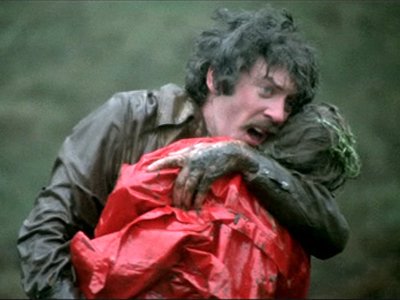
Nicholas Roeg’s Don’t Look Now is visual masterpiece. It is simply mesmerizing in its nuanced artistry. But what is all this artistry in service of? I have come to the conclusion that although the film seems to want to make grandiose statements about life, synchronicity, and the human condition, it is best experienced as a straight horror film. If you don’t expect more than a horror film, this movie is very enjoyable.

But with that said … WHAT a horror film!!! Watching a film like this makes you realize just how far things have slipped in the film making business. Visually there has been nothing close to this for decades, not among mainstream movies with big-name stars in them like Donald Sutherland and Julie Cristie in their primes.  The opening scene is the greatest horror opening of all time; the child’s death and the sequence of events that happen to the couple as they cope is so sad and beautiful I cried several times. The simultaneous tension and meditative splendor of this film, conveyed in every aspect of its making – casting, writing, acting, editing, cinematography – is unmatched in the history of the horror genera. It is pointless for me to try to put it onto words – it has to be experienced.

But let’s just take a simple example. Has a city ever been captured the way Venice was captured in this film? And has Venice ever looked so sad, so humbly and majestically moribund? It’s not just the locations in Venice chosen for filming. It’s the angles it is filmed at, the way the light and sound are captured, the way the different shots are sequenced. It is absolutely exquisite. It is like he captured the transience of life itself, and more importantly the emotion connected to that transience, simply in the way the location was shot. It’s marvelous.

As for the famous love-making seen, it deserves its fame. There is a moment at the beginning of it where … well it’s rather hard to capture the full power of the scene in words because there are aspects that simply must to experience visually, but suffice it to say that Roeg manages to convey, in a single Donald Sutherland expression, the fact that the couple has not made love since their daughter died, and convey the complex grief and loneliness he is feeling, even though nothing up to this point has clued us in to this fact. It is breath-taking, and is an example of the kind of exquisite film making that you just don’t see in modern films. No one could do this now; they would have to put it into dialog, or into some clumsy action (the character pulls away,) or worse have a narrator tell us.

And by the way, it is some of the most passionate and real looking love-making I can remember in film. This isn’t a modern American movie where botoxed actors make love with their clothes on. It’s real, raw, and beautiful.

I don’t know what else to say about the film, except that it moves in slow, graceful steps and the ending is simply overwhelming in it’s simultaneous grandure and humility. It’s probably among the greatest horror film endings of all time.

Posted in Films of the 1970s | Leave a comment

The Parallax View – Pakula Disappoints.

Alan J. Pakula is quite a revered figure here at Irreviews. Klute (1971) and All the President’s Men (1976) are landmarks in the art of the psycho-political thriller, and hopefully I will soon get a chance to review them here on Irreviews to properly extol them. But these films are two-thirds of Pakula’s so-called “paranoia trilogy,” the third being The Parallax View (1974). After recently viewing The Parallax View I am sad to report that it is quite a disappointment.

The problem with The Parallax View is that the story and screenplay are just not very good. Pakula is definitely doing his “Pakula thing” as a director. It should be noted that the scene where Warren Beatty takes the “video test” in the Parallax corporation is rather remarkable – no director today would have the balls to keep that scene going on for that long; in the end we actually feel that we have taken the test. Really great film making. But for the most part Pakula’s talent in simply wasted serving a mediocre script and storyline with weakly drawn characters.

Even the concept of the film is weak. It is inspired by the Kennedy assassination in that a Senator gets bumped off during a campaign event in the Seattle space needle and then witnesses start disappearing over the next few years – lots of witnesses. The first problem is that what makes the Kennedy assassination interesting is the evidence; it is interesting because if you take the time to sort through, digest, and ponder the complicated web of facts in the case it is seen clearly to be a conspiracy, yet the Warren Commission was trumpeting the opposite conclusion. Then, and only then, does it become interesting that witnesses also happen to be disappearing.

But in The Parallax View no time is spent looking at any evidence or anything about the assassination itself. They show the fact that there were two gunmen, and then cut to a committee proclaiming (in an overly sinister way) that there was only one shooter. Then it just dives into the idea that witnesses started dying at an alarming rate. Warren Beatty gets pulled in because a friend who was at the assassination tells him that she is afraid for her life (and why) and then she dies. It’s not a bad step up, I suppose, it’s just not that inspired or interesting. It’s kind of one-dimensional, and this one-dimensionality plagues the movie all the way through. True, in the scene on the boat the guy shows him a couple of photos taken at the assassination, but they are completely uninteresting, as is his commentary, and both are totally designed to re-enforce (I guess that’s the right word) the fact that there was a second assassin, which we already know from watching the opening scene.

Warren Beatty is actually pretty good in his role. But again, the writing is a problem. When he infiltrates the Parallax Corporation, he fools them by getting a hold of some entrance exam and asking a psychologist friend to deconstruct it from the premise that it is designed to identify social deviants that would make good assassins. That’s a really good idea, and could have set up a fabulous scene. But then instead of taking the time to write a scene showing him deconstructing the test, they have the psychologist just happen to have a psychopathic killer kind of hanging around his lab (or maybe he works there, it’s hard to tell,) and suggest that they give him the test and just see what he answers – pretty lame writing, if you ask me.

But when Beatty gets in and takes the second test, it seems clear to me that he passes because he is a social deviant. Now, this was hinted at in some boring and badly-written pieces of dialog between Beatty and his boss Hugh Cronyn. But it needed to be woven into the overall tapestry of the film, rather than just getting airbrushed over the top of certain parts. Beatty’s character should have been a lot deeper. Think of the scene where he first meets the rep from Parallax – he should be convincing in that scene because he probably is a pretty good candidate for their assassin-mill; this kind of nuance is simply lost on the writers.

The action/suspense sequences are in general a little disappointing. The scene at the dam is not too bad – it has its merits; the sailboat and airplane scenes are just okay, not great. Well, okay, maybe the airplane scene is pretty good, in certain ways; I’ll go that far!

I found the drawn-out last quarter of the film and all that shit with the band a bit boring. And as for the “clever” ending that is supposed to give you chills when you realize what actually went down, well it wasn’t awful, but I just don’t think that they set the whole thing up well enough to have it be really convincing and chilling.

The Parallax View is not a bad film, but it is no where near the other two films in Pakula’s “paranoia trilogy,” and is definitely not a timeless movie you would return to over and over. But I don’t mean to be overly harsh about it. By the standards of most of today’s dreck it’s … well, a bit better, at least. And after all, how many films written like Klute can a director expect to stumble into in his career?

Posted in Films of the 1970s | Leave a comment

4 months, 3 days & 2 weeks – palm d’BORE

Okay, Palm d’Or winner here. I lasted about half an hour.

Two jerky, weirdly unsympathetic women trying to get an illegal abortion in Communist Romania. They meet up with a drone-like thug who apparently gives abortions and go to a hotel room with him where there is an ENDLESS scene of the thug being a complete nasty condescending prick to the girls until finally we learn (surprise, surprise) he wants to fuck them both in return for administering the abortion.

Flat acting, no character development, uninspired  camara work and bad sound. What a colossal bore.

Posted in 2007 | Leave a comment

The 2009 Oscars – who will win?

These are NOT my picks – these are who I think the Academy will choose.

Best Picture and Director: Slumdog – a new low in Oscar history: a game show wins best picture.

Best Actor: Sean Penn -they finally give him one.

Best Actress: Kate Winslet – they like her, and this year’s Holocaust film has to win SOMETHING big.

Best Supporting Actress: Penelope Cruz – it always goes to the hot young babe, at least lately.

Best Supporting Actor: Heath Ledger – it just has to be.

Posted in 2008 | Leave a comment

New In Town – A subversive little diversion

A light romantic comedy, not super funny, not super romantic, and with a leading lady whose face does not move. However, the ending of the film throws an interesting twist to the viewer that is quite subversive in this society full of struggling working people obsessed with the welfare of mega-billionaires. I think this is why it did not do very well.

It’s WAY better then Shopaholic, that I can assure you. It’s a good, earnest romantic comedy – go see it for some light fun.

Posted in 2009 | Leave a comment

Juno – snappy, watchable, but not a great film

One of the best films of the year (2007)? Hardly.

Juno is written with quirky, snappy dialog that is a lot of fun to listen to, and Ellen Page has a great voice to deliver the lines with. The story is decent, but there is just no depth or texture here – it’s a little like the Glimore Girls (in the final seasons of that show, when the writers were phoning it in.)

Additionally, the score is not good. In fact, it’s quite bad, and this hurts the film.

Ignore the people who say the film is “pro-life.” They’re full of shit.

The film does not stand up to repeated viewing very well, but it is pleasant enough entertainment the first time around.

Posted in 2007 | Leave a comment

Vicky Christina Barcelona – not too bad, for Woody Allen

I lost interest in Woody Allen in the mid 90s. I decided that I hated almost all his work (including his early “good” stuff) in early 2000s.

This film is somewhat of an exception, and might be the only Allen film I can stand at this point. It still suffers from Allen’s painfully stilted dialog, but somehow Javier Bardem and Penelope Cruz take his crap writing and do something good with it. I don’t know if they really are brilliant actors, or if it is just that their Spanish accents make Allen’s hackneyed dialog sound fresh and interesting – maybe a bit of both. Scarlett Johansson remains “lips without a face”, but Rebecca Hall is quite good playing the “Woody Allen character.”

It also has incredibly beautiful scenery, a good score, and is very well shot.

Probably one of the more enjoyable mainstream movies of the year.

Posted in 2008 | Leave a comment