The Informant! – an unfunny farcical treatment of a serious story

When I walked out of the theater after seeing The Informant!, I had kind of a slimy feeling. The film is a true story, re-envisioned as a light comic farce designed to heap ridicule on the main character played by Matt Damon – the main comic idea is “can you believe this whack-job?” But later on in the movie you realize that he actually had very serious mental problems and probably snapped because of the reckless way the FBI threw him into a high-stress assignment of corporate spying. In the end I felt kind of sad for the guy, and resented his deliberate portrayal as a ridiculous clown. He struck me as a smart, sort of amoral, and very troubled individual pushed over the edge and then crucified for it.

Still, there are elements of humor in this strange tale that could have been explored in a non-exploitative way, but rather than write and create a genuinely funny and honest movie, Scott Burns and Steven Soderbergh decided instead to rely on a rather clumsy, highly manipulative score by Marvin Hamlisch designed to communicate with every note that we are watching a parade of clowns and to mechanically trigger our laughter and derision. The score is basically Hamisch’s score from Woody Allen’s Bananas, reworked and updated a little to include some Ocean’s 11 type 70’s jam sessions. But this style of music worked in Bananas because a) the dialog in Bananas is well-written and really funny, and b) Bananas actually IS an over-the-top, made-up farce that is completely ridiculous. The Informant! is the opposite: a completely unfunny farcical treatment of a real and serious story.

The humor in the film comes in two flavors. First we have all the “outrageous” things that Damon’s character Mark Whitacre does (and the corresponding reactions of the people around him.) All the best moments are in the trailer. They weren’t that funny to begin with and they are considerably less funny in the actual film because the film lacks a continuous comic structure to hold the viewers anticipation of humor and enhance key comic moments, and thus they fall flat. In addition, I was really surprised at what poor comic performances Soderbergh got out of all the supporting actors – they’re just terrible. This really hurt the film. Consider for example the incredible range of comic reactions to Dustin Hoffman’s weird behavior in Tootsie to get some perspective on how important this element is to films of this type, just how well it can be orchestrated by a master filmmaker like Sidney Pollack, and the magnitude of Soderbergh’s failure in this regard.

The second flavor of humor is Damon’s constant interior monologue, which is designed to show what a crazy freak his character is, his mind racing all over the place in the middle of serious conversations. It’s the kind of thing you chuckle at in the beginning but by mid-way through the film it’s not so funny anymore because by that point you realize that there is no real comedy in the film and these silly monologues are as good as it’s going to get.

Damon saves his character from completely drowning in this mess through his considerable on-screen charm and charisma, but he comes no where near saving this lumbering elephant of a film. I realize that The Informant! is getting widespread critical acclaim, but to me this is just another embarrassingly bad comedy in an era that will go down as a comedic dark age. Let’s hope for the Renaissance soon!

Posted in 2009 | Leave a comment

Bright Star – striking visuals run amok

This film is two hours long. It felt like three hours.

I’ll admit, I have a limited tolerance for these period dramas. Basically, it has to have a fantastic story and fantastic dialog for me to like it – think A&E’s Pride & Prejudice, BBC’s Persuasion or Bleak House, or maybe even Emma Thompson’s Sense and Sensibility for some examples – or else I find myself getting irritated at the uniformity and predictability of this genera. Bright Star has neither. The story is pretty minimal and one dimensional – boy meets girl, they fall in love, ends tragically. You don’t really ever find out what makes either of them tick. The dialog is no where near what it needed to be to make their rapid falling in love believable. Listening to them endlessly recite Keat’s poetry does not really clarify anything. You don’t find out much about Keat’s professional struggles beyond “my book is not selling, I have no money.” You don’t get to know her or find out why she is so spiritually (and sartorially) modern. The other characters are not really developed, even minimally as supporting structure. They’re all just cardboard placeholders.

I think the film lacks these fundamentals because Jane Campion was too busy obsessing over visual images. We are inundated with a constant stream of striking and beautiful visual images – distorted images of people through panes of glass or reflected in still ponds, ensemble images in exquisite flowering fields, graceful use of re-focusing and intentional blurring to create impressionistic effects, and some of the most detailed images of hand sewing I have ever seen. This is not necessarily a bad thing. But the problem is that the images are not in the service of the story. The images dominate the story. When almost every image looks as if it was planned to be the most memorable image ever, something has gone terribly wrong.

Think of how a truly great film like Enchanted April uses striking, static images: very sparingly, and always in a way that does not disrupt the viewer’s engagement with the story itself – the images support the story and the development of the characters, without exception. Bright Star is the opposite. Examples abound, so I’ll just pick one: the images of the younger sister fascinated by the butterflies are incredibly beautiful – really, I don’t think I have ever seen a child’s fascination with nature captured … with such artistic flair, let’s say. The problem is that it has absolutely nothing at all to do with the story. Even tiny things like the maid handing a coin to a delivery boy are done with a completely excessive amount of artistry. Bright Star is overrun by these visuals, partly because too much time and energy has been invested in their creation, and partly because the characters and story completely fail to distract us from them.

Let me also say that in my opinion the younger sister gets way too much airtime in this film. Sense and Sensibility got it right: there the third and youngest sister Margaret Dashwood has a few scenes with Hugh Grant, mainly to establish what a cool and likable guy he is, and then BOOM: she is gone for the rest of the film! Here’s the rule: if you can theoretically eliminate a character from a movie and have the main story lines remain completely unchanged, then this character should not be an artistic focal point of any kind.

As far as the acting goes, Ben Whishaw is good and very likable as Keats. Abby Cornish (who was really good in Stop Loss) was okay, I guess – she does some nice crying, but in general she plays it a bit too cold, hard, and modern for my taste. I was really surprised to see Paul Schneider in this film. He’s one of my favorite off-beat actors, but I am used to seeing him play American weirdos. It took a while for me to get used to him in this role, but then I basically liked him. He more or less brings his usual striking combination of frenetic energy and heartfelt warmth to this role.

As for the music, there is one little theme that is pretty effective, but their application of this theme in the telling of the story is inconsistent and sloppy, which limits its power. The duet at the beginning and the end I could really live without – I love that kind of thing, but this particular recording just sounds weird and irritating to me.

Another dud film in a really dissapointing year of cinema.

Posted in 2009 | Leave a comment

The Cove – a “save-the-dolphins” activist commercial

The Cove is a “save-the-dolphins” activist commercial, and there is absolutely nothing wrong with that, as far as it goes. A group of fisherman in Japan is butchering dolphins for food, and the mercury-poisoned meat is being force-fed to Japanese school children and being falsely sold as whale meat. The world would be a better place if this was not happening, obviously. I say definitely add it to the list of thousands of awful injustices happening every day right under our noses that together signal the impending doom of our species. And I think it is quite proper to never attend a dolphin show or a swim-with-dolphins program, in the hopes of economically stopping the slave captivity of these animals.

But that is as far as I am willing to go in praise of this film. I do not really consider it a documentary – it crosses a line with its aggressive and single minded agenda. Its frenetic, hectic style, overly loud music, and poor rhythm and lack of detail make it kind of unpleasant to watch. The “Oceans 11” stuff (which I’ll admit was the main reason I went to the film) was really disappointing – it’s just badly done, with few details and inadequate explanation for it to be truly exciting.

In my opinion, The Cove over-vilainizes the Japanese government for buying the political support of small countries in the IWC to protect its right to kill dolphins. Consider the horror and death that we (the United States) inflicted on the countries of South America during the 20th century to protect the profits of American companies, or the horrors inflicted on Iraq over the last 20 years over our lust for their oil. This is how powerful governments behave – Japan is just defending their right to do what they want, just like the US does all the time on a much larger scale.

It is also a bit glib on the issue of “dolphin self-awareness.” There is research that suggests that bottlenose dolphins have some degree of self-awareness – there are many different species of dolphins – and the results of this research have been criticized in interesting ways. I think a proper documentary would have been more detailed and honest about this, rather than just tossing it out there to manipulate us into caring about the dolphin slaughter. Personally, I’m against their mass slaughter even if they are NOT self-aware.

Lastly, how is this slaughter different than the way cows, pigs, and chickens die in US slaughterhouses? Have you ever seen under-cover footage of how those animals are tortured and die? Believe me, it is every bit as bad as the dolphin horror show shown in this film. Pigs are also really smart animals. Do you think the poor pig writhing to death with its throat slashed on the floor of a slaughterhouse is happy about it? And shouldn’t we be more concerned that it is animals like this pig (and the fucked up energy of its miserable life and horrible death) that we as a society are ingesting, and not the dolphins on the other side of the world (who unlike the pig actually did know freedom most of their lives.)

Again, just for the record, I like dolphins, I’m against commercial dolphin captivity (or ANY dolphin captivity for that matter,) and I think dolphins should be protected from commercial fishing, like whales are. I just want to cast some perspective on this very aggressive “documentary,” that’s all.

Posted in 2009 | Leave a comment

Bandslam – one of the best films of the year

bandslam0

My wife and I went to the early evening show on the opening day of Bandslam in New York City. I was expecting to be overrun with teenagers. Instead, the audience was filled with nothing but Generation-X couples! As my wife pointed out, this is because no one knows how to make a “date film” anymore. Bandslam is quite frankly the best option out there this year.

Bandslam is the best film I’ve seen all year. This may sound a bit strange, given that it is a “corny, teenybopper movie” with Disney stars in the lead roles. But my point is that it is a really good corny movie, and in our society filled with emotionally cold movies, emotionally cold books, and emotionless robotic music, corny movies are one of the last bastions of artistic emotional expression we have.

Bandslam has its flaws, certainly. The leads are all slightly problematic in their own way, and no one would call this film “deep.” But the screenplay is smart and well-written, with lots of good dialog (very unusual these days.) It has tons of kick-ass modern pop music, played in exciting, well-filmed performances. It has an entertaining variety of themes running through it – kids coming together to form bands, love blossoming from friendship, alienated nerds coming into their own, arrogant pretty girls growing a heart, an interesting mother-son relationship, people reacting to difficult circumstances or dealing with unfortunate pasts, and last but not least the pure, spontaneous joy of music. These themes are not developed down to the emotional core of our being – the film is quite light – but they are developed, which is more than most movies can say.

Most importantly, the film is just plain fun, start to finish, and has a positive uplifting spirit which just sweeps away any minor issues about casting, performances, or the thematic depth of the film. The positive spirit and good energy of this film defy the critics, and that is why they were so mute and gutless in their reviews.

The music written for the various bands to play is terrific. Usually in films like this the music is downright lame. No, it’s not Fame-great, but what music performance film in the last 30 years has come anywhere near the music written for that 1980s classic? Besides, Bandslam is not aiming for quite the same effect. This film is about the raw excitement of loud, raucous pop music played live, and they really capture that in all the performances. They capture the joy of making music, and the joy of being thrilled by music, and they do it quite well. Plus, there’s a lot of pop music history and philosophizing woven into the film, giving its dialog a very pleasing texture. Lastly, the film also has a really good soundtrack, and uses it well.

bandslam11

The leads are all really solid, and as I mentioned before any small problems with their performances don’t really effect the enjoyment of the film. By the way, I thought Lisa Kudrow was really good in her supporting role as Will’s mother, and in my opinion she transcends her famous tics pretty well to create a warm and real character.

This movie is not shy about playing on Generation-X nostalga. The scene at the piano is straight out of Fame (and Gaelan Connell even looks like Bruno.) The band’s opening song is Cheap Trick’s “I Want You To Want Me.” The Velvet Underground is considered “essential listening.” Will waxes poetic about the Ramones, Patti Smith and The Clash. Everyone in the band is instantly familiar with the “harmonized guitars of Thin Lizzy.” Charlotte drives a 1970’s convertible sedan. Will has “Wichita Lineman” on his Ipod. The band’s drummer is 1980s Matt Dillon, time-warped in. David Bowie is featured prominently, as is CBGB’s. And only in the 1980s does $10,000 represent a significant record deal! Like the other great teenybopper movies of the last fifteen years – films like Ten Things I Hate About You, Bring It On, and CluelessBandslam is really written for Generation-X.

At the end of the film, the audience clapped and cheered enthusistically; no one clapped or cheered at the end of Cold Souls, I’ll tell you that! Movies are about having fun, and even if Bandslam does not totally stand the test of time, and winds up just being the best of a weak year of films, it is still lots of fun! I highly recommend it!

bandslam00

Posted in 2009 | Tagged , , , | Leave a comment

500 Days of Summer – An Annie Hall Music Video

This film is sort of entertaining, I guess, but it really does not amount to very much. The filmmakers are clearly influenced by Woody Allen (a lot of the style is lifted right out of Annie Hall, it seems to me.) But the problem, as with so many films, is that the filmmakers didn’t write enough dialog or flesh out the characters properly to support this kind of film. Plus, they try to cover the weak writing and story with all kinds of cutesy gimmicks (spontaneous dance numbers, “Science of Sleep” visual effects, a bizarre, deep-voiced narrator straight out of a nature special, etc..) I will say this: it does have a really good soundtrack, even though the filmmakers make rather uneven and sometimes clumsy use of it in the film. Actually the soundtrack is decidedly too good for the material it accompanies. The music overpowers the bland storyline and as a result the film crosses a line somewhere and is more like a giant music video.

I am a big fan of Joseph Gordon-Levitt, and I continue to believe that he has something, a certain cinematic soulfulness, that has just not had its chance to shine. Because he bears a weird resemblance to a plastic action figure, he is getting typecast in Hollywood. I always wanted him to take a romantic lead to see if the deeper side of his acting could come out, but unfortunately this film is not the vehicle I was imagining; its just not very well written, and his character gives him almost nothing to do, although he tries his best. The scenes of him singing Karaoke were, strangely enough, my favorite parts of the movie.

Zooey Deschanel, on the other hand, is not an actress that I feel has hidden depths. She is just a one-note weirdo with really big eyes, and she does her usual thing here in this film. The two have no chemistry, and I think that is her fault.

Not bad for a summer distraction, if your expecations are not too high. But it’s really not very good, in my opinion.

Posted in 2009 | Leave a comment

Post Grad – Painful!

My wife and I went to see Post Grad on our vacation. Why we would ever do such a thing is difficult to say. Basically it comes down to the fact that it is an Alexis Bledel movie, and we were big fans of the Gilmore Girls. Now, with this film under our belts, I can safely say: NO MORE ALEXIS BLEDEL MOVIES unless there is some other substantial draw which promises to carry the movie despite her.

The worst thing about this horrible movie is that the filmmakers decided to cast the decomposing body of Carol Burnett in the role of the grandmother. The New York Times described her performance as “scarily wooden.” This is code for “she has had so much plastic surgery that she now looks like a Chucky doll.” She had more wrinkles thirty years ago in The Four Seasons than she does now, and she has fewer wrinkles than her daughter-in-law in the movie (Jane Lynch). I was literally surprised every time she successfully spoke in the film. Her appearance is so shocking and offensive that she should be banned from movies, along with the little freak who played her grandson (Bobby Coleman) who is similarly frightful and emotionally upsetting to watch and listen to. Or, if they don’t want to ban her, they should at least do a Benjamin Buttons on her and CGI-age her to resemble a semi-normal, 66 year old woman – the technology is there, why not put it to good use?

I though this film was going to be about Bledel’s foibles in trying to find a job. No. Instead, it is the story of an exceedingly offensive and unlikable family of morons, the Malbys, that we as the audience are asked to side with, root for, and relate to. Herein lies the pain! Don’t be taken in by the carefully constructed preview, which makes the film look like an Alexis Bledel romantic comedy, completely minimizes the wretched family, and implies a love triangle that is simply not there. It’s a ruse to hide the horrible reality of this film.

The climax of the film is when the family bonds in supporting the little freak as he participates in a box car derby (this gives you some idea of how boring and hopeless the Alexis Bledel storylines are.) At the end of the race, his breaks fail and he goes careening off down a hillside, landing upside down in a lake. I smiled and thought to myself “one less Malby.”

As for the humor in Post Grad, if you think a guy stepping in cat shit over and over and over is funny, by all means see Post Grad. Honestly, I know the influence of the Rogen/Apatow/Smith jugernaught is donimating comedy right now, but it IS possible to write humor that transcends first graders laughing at their own poop.

Posted in 2009 | Leave a comment

Islander – a wonderful film!

My expectations for Islander were pretty low, but wow did it surprise me. Very rarely do you see a film like this – a gritty, minimalistic story set in a strong cultural environment – that has anything like the pacing, rhythm and warmth that this film has. Usually what happens in movies like this is that the story gets lost in the accents, the sets and the technical details of their lives, which are used to cover a dull storyline, bad dialog and poorly developed characters. Not here! The story is really compelling and interesting in a totally low-key kind of way. The dialog is really strong, and moves from minimalistic exchanges to deeper conversations with great skill. Plus it has a really nice score, and makes good use of it.

All of the characters are interesting, even the lesser ones. Thomas Hildreth and Philip Baker Hall are simply terrific in their roles!

I don’t know if I’ve ever compared a film to that masterpiece from the 1990’s Ruby In Paradise, but the pacing and atmosphere of this film reminded me of that old classic from the 1990s film Renaissance. I am not sure yet if it will prove to have anything like the repeat watchability of a truly great film – it might – but it is certainly a must-see film.

Posted in Films of the 2000s | Leave a comment

It Might Get Loud (and it does)

As a guitarist and songwriter who in my youth liked Led Zeppelin and U2,  I was really excited to see this film. Although I did enjoy small parts of the film here and there, I must admit it is not a very good documentary and is in fact rather disappointing.

I thought this film was going to be the three composers talking all about how they approach and craft rock guitar music  – that is certainly what the preview led me to believe. Boy was I wrong. The live discussion is really stilted and dull – one makes a generic statement and the other two smile and nod. And the solo segments are not much better. The Edge mumbles one sentence about how he voices his E chord, and that’s it for his playing approach. Oh yeah, and they point out he uses “effect pedals,” as if this was not obvious.  Similarly for Page – I read an long interview with Jimmy Page (freely available on-line) done a while ago that was 10-times as interesting as the stuff he says in this film. As for Jack White, he’s not really a craftsman but more of a spontaneous freak-show. His approach is to “pick a fight” with his guitar, and you see a clip of him teaching his son to stomp up and down on a guitar fretboard.

Then there are all these extended scenes of them giving solo performances of guitar parts from their songs, or of all three of them playing in unison a guitar part from one of their songs. These sound REALLY boring taken out of the context of the song from which they came.  I suppose they could have discussed WHY they sound so boring and unimpressive separately and explain how the parts are meant to function sonically within the songs, but that is way beyond the vision of this documentary.

Jack White’s contributions have the additional feature that he sings through ear-splitting distortion and his guitar (and piano) are badly out of tune, on purpose of course (otherwise he would just tune them before performing.) This put me in mind of the scene in Bandslam where Will points out the band’s guitar and bass are out of tune, the lead signer replies “we don’t want to come across as too polished,” and Will responds “I don’t think you have to worry about that!”

The bio segments are pretty plain vanilla. Nothing to get too excited about, that’s for sure.

The documentary just disappointed me in so many ways. There is nothing interesting on the guitars themselves. Nothing on how The Edge created his famous echoing rhythm guitar sound or how he layers his effects, or even what his effects are. Nothing on how Page crafted the Zeppelin sound, or on his views of how this sound was an evolution of older rock and blues. Page says over and over “the critics didn’t get what we were trying to do,” and I’m thinking, “yes, why don’t you tell us what you were trying to do?! THAT would be interesting!” They don’t even explain why Jack White feels you must “fight” with your guitar, when clearly Page and The Edge do not share this rather violent and combative approach to the instrument.

In all fairness, I should mention what I did like. I liked the rock version of Froggie Went a Courtin’. I liked Jack White’s talk about rock minimalism and spontaneity. I liked most of the stuff The Edge said – he came across as a really thoughtful and humble guy. Lastly I enjoyed learning about the White Stripes, primarily because in The School of Rock, Meg White is volunteered as an example of a “great chick drummer,” and I always wondered who she was!

By the time I got out of this film, I had fog-head from all the noise, and was in a bad mood. I felt like I had spent two hours listening to a bunch of teenage hacks with their amps cranked, fucking around with their guitars – it was frequently loud and irritating, and did not sound good!

If you love any of the artists involved, or if you love blues-rock guitar so much you’ll watch anything featuring this kind of playing, the film is probably a must see regardless of its flaws. Otherwise, I would think twice – watching the (rather excellent) preview might prove to be enough!

Posted in 2009 | Leave a comment

I Love You, Man – a really good comedy about male friendship

iloveyouman

I Love You, Man explores male friendship with humor and dignity

I Love You, Man is an example of that rare beast: a modern, non-intellectual comedy that is not a parade of sub-moronic comic cliches, unbridled crassness, obnoxious stereotyping, and third-grade poop-humor. Instead we are here treated to a genuinely funny and heartfelt exploration of male friendship and a rather sensitive portrait of a certain type of man (Rudd’s character) who feels more comfortable with women, and who over the years has lost most of his male friends and now seeks to try to make some later in life. I found myself laughing for days thinking about the various scenes and lines from this film, and even the few instances of low-brow humor in the film are done so smartly and spontaneously that for a change they are actually funny. This is the advantage of having a comedy rest on the strength of its story, rather than the cynical manipulativeness so pervasive in comic films these days.

The performances of the two leads are really marvelous. Paul Rudd plays the awkward and nerdy Peter Klaven with a warmth and humanity that you usually don’t see in this type of comic character. Rudd makes the humor associated with Peter’s awkwardness funny and really hard to watch, but he never over-plays it, nor does he take the easy road of serving up a shallow stereotype. You still really like Peter despite everything (just as his fiancee does in the movie.) Rudd is simply a terrific actor, and this film really lets him shine.

Jason Segel is really fabulous as the cool but highly flawed and sometimes gross Sydney Fife, and his subtle performance really puts to shame the many performances of Seth Rogan in this very same type of role. Segel brings real depth to this character without ever letting him slip into a Roganesque idiocy and foulness. Sydney is a great guy, but also a really strange and in some ways unlikable guy. But you love him anyway because of the quiet warmth of Segel’s performance. Together, Rudd and Segel give us a wonderful portrayal of just how little surface-level idiosyncrasies really matter in the face of true friendship.

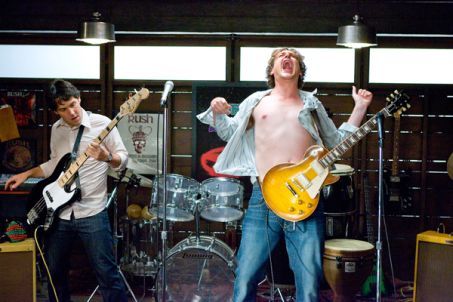
I found the scenes of the two guys bonding over their love of the band Rush to be surprisingly charming. Generating cheap humor out of the fact that 1980’s nerds adored Rush is beyond cliche at this point, but this film actually takes the high road and captures the joy and giddiness that these two geeks-at-heart jointly feel about the band.

large_Love-You-Man-453

Consider the scene where they fire up the amps and play Tom Sawyer, Sydney on guitar, Peter on bass, and both of them singing.  The scene is wonderfully honest and real and captures not only their nerdiness but also their genuine shared happiness. When they get to the drum break, they (like classic 1980’s nerds) “sing” the Neil Pert drum break as they play their instruments, and somehow this little display of extreme uncoolness comes across as the good-natured fun that it actually is, and you don’t look down on them at all. You don’t see this kind of restraint very often in comic films these days – it’s very refreshing.

The film was marketed around the simplistic and canned idea of guys being man enough say “I love you, man,” but by the time you get to the end of the film you have actually forgotten all about this concept, having been completely won over by the intelligent, insightful and funny story. As the two friends are re-united at the end and express their heartfelt male affection for each other, this film rises up to be genuinely moving without becoming smarmy, or overly serious, or descending into parody. It’s a wonderful ending to a really good film.

Rent it and enjoy!

Posted in 2009 | Leave a comment

Cold Souls – a postmodern downer in sheep’s clothing

I am not a fan of Charlie Kaufman-type movies, but I went to see this film because I really like Paul Giamatti. I am also fond of Emily Watson and David Strathairn, so I figured: what the hell. After all, the filmmaker Sophie Barthes says she is not very influenced by Charlie Kaufman, so I figured maybe there’s a chance that it will not be a shallow, pretentious, intellectual farce that goes nowhere.

Barthes’ film is not as screwball as Charlie Kaufman’s stuff, but it is also not as funny or entertaining. It’s not really funny at all. Yes, in the beginning the audience was laughing a bit, and I smiled a few times, but that was because of Paul Giamatti’s quirky reactions and delivery (which are amusing in general.) The comic material itself was quite bland and uninspired, and the pacing of the film totally did not support the comedic moments at all.

But soon you are actually wishing for more of these dull attempts at humor because the film quickly drops all pretense of being a comedy and turns into a post-modern downer. What this film secretly aspires to be is a serious, moody art piece making some grandiose statement about the soul and the human condition, or something like that. When I saw the film, the audience full of giddy New York City hipsters and intellectuals went dead silent after the first quarter of the film, and didn’t seem particularly happy when they left the theater.

The problem with this film being a post-modern downer is that it doesn’t really have very much to say. The film never deepens past the twin surface-level concepts: that evil Russian gangsters are trafficking souls, and Paul Giamatti stores his soul in a facility and it gets stolen. These two surface concepts feel pasted together in the film, and in the end all you can really say is that this pasted-together storyline is rather methodically and unoriginaly  resolved.

The film appears to want to make an artistic conjecture about what it might be like to have another person’s soul inside you, but all Barthes can think to do along these lines is to keep showing these blurry scenes of people “seeing” into their foreign soul, scenes that are kind of like Harry Potter flashbacks (and that is NOT a compliment.) These “soul peering” scenes are totally lame because they are not beautiful or interesting and at the same time it is not clear what you are supposed to be taking away from them. They are just inscrutable filler. In the end, Paul Giamatti looks into his own soul – the pivotal moment of the film – and I have NO idea what his vision meant, nor do I care. Clearly something went wrong here.

Then there are the Russian gangsters, who like all movie gangsters are just cardboard pricks exhibiting zero emotional range, and are therefore completely and utterly boring to watch.

This film is muddled and confused. It wants to be a screwball comedy, a sort-of action film about Russian gangsters and “mules,” a arty mood piece about soul transplantation, and a witty-but-profound culture critique about the emptiness and desperation of modern western life. In my opinion, it fails at all of these.

Paul Giamatti, as usual, turns in a really good performance given the material he is stuck working with. In particular, the scenes of him acting Vanya with various souls in him were really great (probably because the beautiful Cechovian monologues  gave him something more to work with.) But they only last a grand total of about 3 minutes in a 100 minute film. It would have been better to explore this more and cut the damn gangsters! He really acts his heart out for the entire film, but in the end my conclusion is that he is simply too good for this material.

I have NEVER seen the marvelous Emily Watson give a nothing performance, but I guess there is a first time for everything. She couldn’t even convince me that she was Paul Giamatti’s wife, that’s how bad her performance was. Of course the writing and direction are to blame, not her. David Strathairn is good but a bit wasted in his doctor role. Everyone else was pretty forgettable.

This film is getting great reviews, but to me it is just another mediocre downer/comedy with semi-big stars in it, like Synecdoche, New York. It’s not a horendously bad film, like Synecdoche is, but it is rather dull and disapointing. Despite Paul Giamatti, I can’t really recommend it.

Posted in 2009 | Leave a comment