Breakheart Pass (1975) – when shit looked REAL!

Breakheart Pass: when stuff in films looked real because it WAS real!

If Breakheart Pass was being made today, there is no way they would haul their asses out to the middle of fucking nowhere and shoot everything live on an actual moving train. They would phone up the CGI unit, who in turn would cook up a (completely fake-looking) computer-generated train on which to superimpose the actors. They would then slap on a colored filter to mute the fakeness of the train by making everything look fake. This is the general formula nowadays, at least for outdoor, large-scale action shots. It drives me crazy. Think, for example, about how fake 2012 looked, or Shutter Island, or Inception, or virtually any recent war film, or even earlier, consider the fakeness of  The Lord of the Rings, Part 1, 2 and 3. The problem is widespread and insidious.

All this CGI started out as an ill-conceived novelty, but more and more it appears to be simply a cost-cutting measure. And what is worse, there is a mindset developing that it is simply not worth the time, money or effort to capture anything realistically, because the audience has shown that it will consume the fake-looking shit with nary a grumble. I really don’t know how people can keep going to these movies. Is it that movies and computer games have become interchangeable experiences for a large majority of the paying audience, so they don’t really notice? Is it because the younger generations have never really seen how incredible action movies looked in the past? I don’t know. For my part, I’m grumbling.

First, a few words on the movie itself. I like to think of Breakheart Pass as a quaint and fun little B-film from the seventies, but actually I think it was supposed to be a pretty big movie at the time, with established stars like Bronson, Ireland, Charles Durning, and Ben Johnson. It even had Paul Newman’s son in a bit role. Watching the film now one is struck by its simple, unadorned narrative structure which to our modern eyes and ears seems hokey and unsophisticated. As my wife pointed out, the dialog and story structure is so simple it’s actually a great movie for kids (maybe this is why I liked it so much as a child?) The film could be rated G except for a few really mild bloody scenes – I don’t think there is a single curse-word in the whole movie.

But if one can get past the initial reaction that it seems like a pokey, dated little B-film, one sees that the story itself is actually tight, well paced, and interesting. Moreover, it is an incredibly soothing movie, with a really nice rhythm. The performances of the main actors are solid – the exceptions are the guys playing the Major and the Reverand, who are a bit stilted, and Jill Ireland, who … well she’s  always struck me as a pretty feeble actress, but my God did that woman look great!
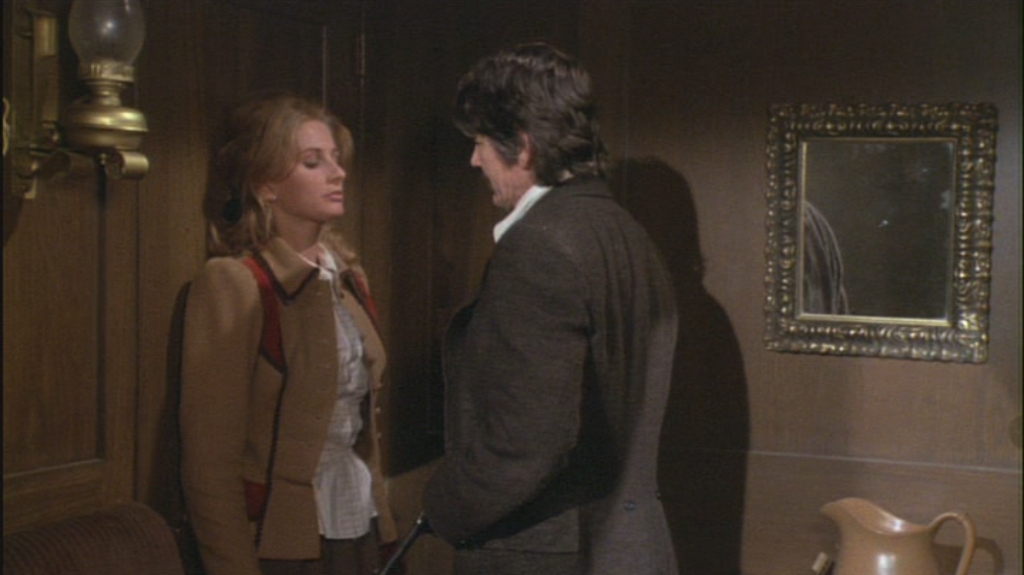
Jill Ireland: So good looking, her acting ability is irrelevant.

As for Charles Bronson, it’s amazing to be reminded how great the old-time movie stars were, even in B-films like this. Not only was he a solid actor, but his presence on screen and his amazing voice are the stuff that can carry an entire movie. What’s sad is that no one looking like Charles Bronson would ever become a star nowadays. He’s too ugly! And he’s not completely ripped from head to toe, with abs, pecs, guns and 0% body fat. But really, isn’t it more exciting to watch an action film with someone who actually looks like a man of action, instead of some pretty, baby-faced jerk-off who is cranked on steroids?
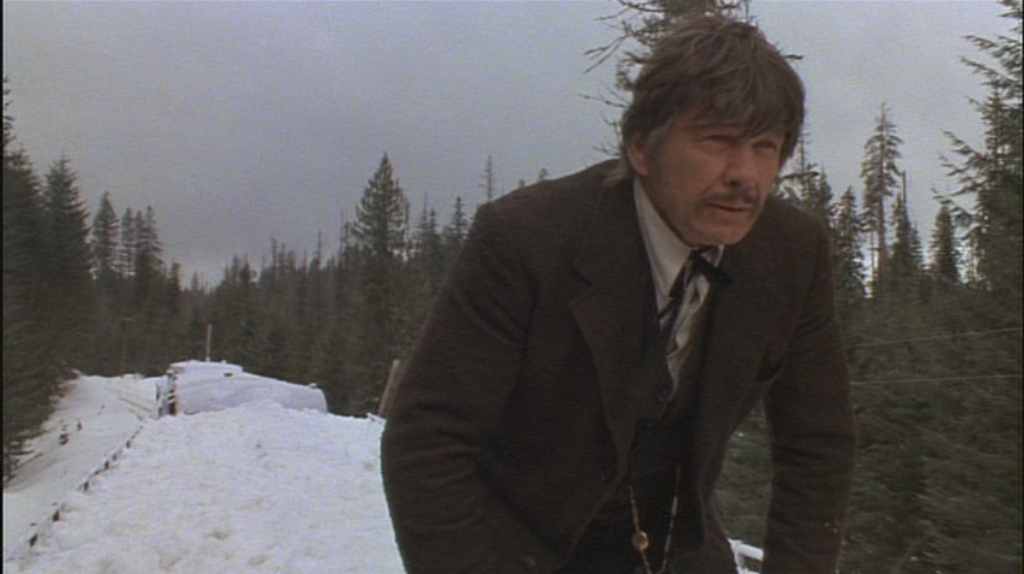
Charles Bronson: what a real action hero looks like!

Finally, I should point out that the score of Breakheart Pass (Jerry Goldsmith) is absolutely fabulous.

Breakheart Pass creates a seductive visual world of the kind that you really don’t see anymore in films. There are occasional exceptions, but it is really rare nowadays. Because the train was real, and the terrain was real, the viewer is immersed in the culture of wilderness rail transport, and the results are mesmerizing.

What Breakheart Pass has is visual texture. There are so many scenes that are unforgetable simply because of the way they look. Even the simplest scenes, like the scene of the soldiers in a line tossing up chopped wood into the engine, you never get tired of watching. Every time the train steams around a bend, it is exciting and transporting all over again. Perhaps the best example of this phenomenon is the scene at the tressle bridge where the fireman falls to his death. The sense of place that is created in this scene is incredible, especially by today’s impoverished standards.  It’s just beautifully staged, and the scene sticks with you even though not much happens in it – it sticks with you because it looks so great it’s like you’re there!

Texture: you want a shot of people looking down from a tressle bridge? Make the effort to actually film it for real!

Then there are the action sequences. Let’s take a look at the fight on top of the boxcars. When one sees this scene, one is stunned at how exciting action sequences used to look when they were simple and real. No CGI, no fancy chopping, no choreographed slow-mo shit to be sped up later so everyone moves like The Flash. They simply set a moving train going through real snowy terrain, put two stunt-guys up there, and filmed them fighting! What a novel concept! And the results are, to my mind, thrilling. This is what movie makers do not get anymore – simple is more exciting and more interesting.

The boxcar fight – stationary camera, real train, real snow, real fighting.
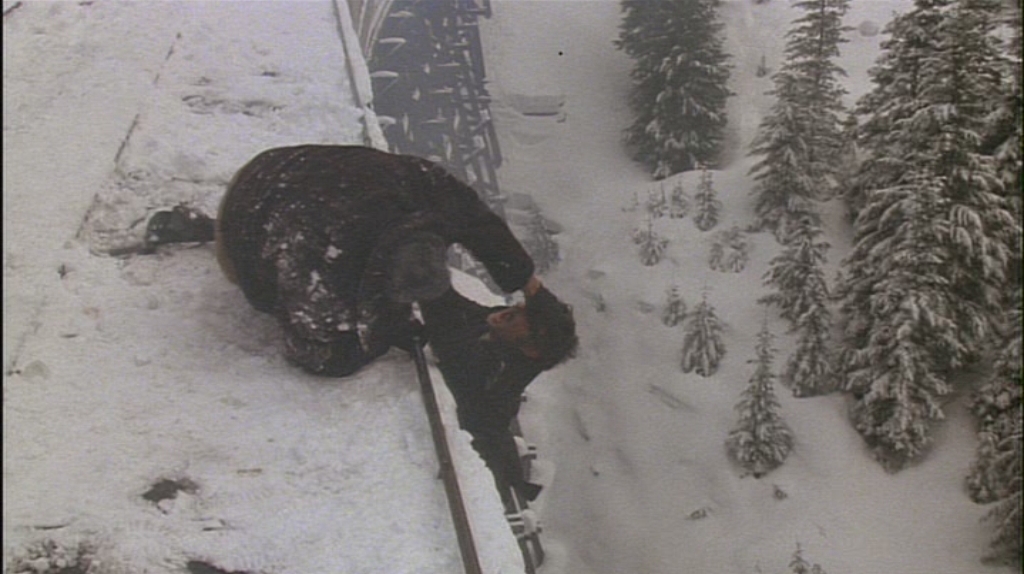
When was the last time you saw an action scene that looked THIS good?!
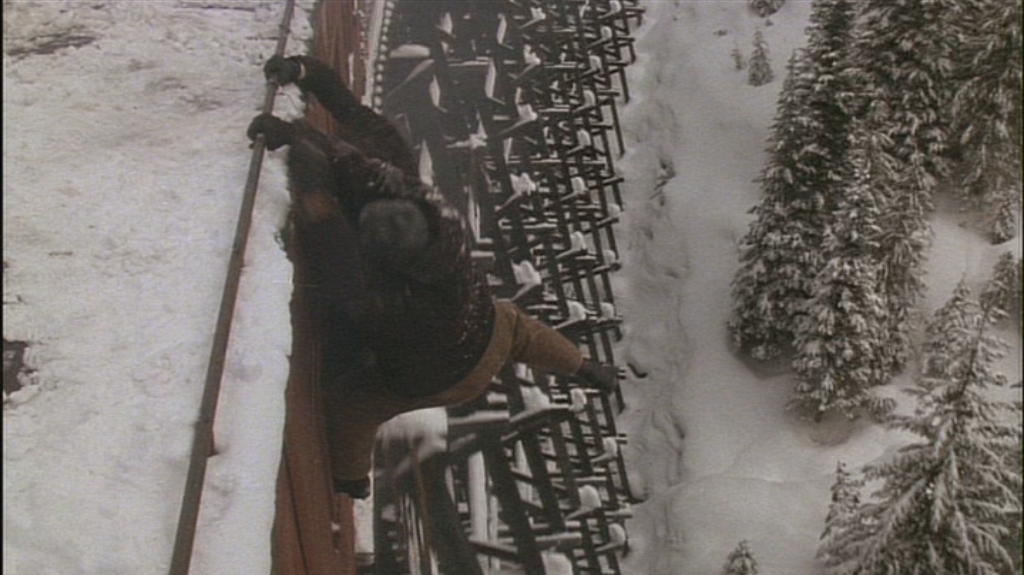
Keep in mind that the train is moving throughout the scene.

Anyway, if you want a really pleasing little film experience from the 70s, I recommend that you Netflix Breakheart Pass and check out how marvelous things used to look, and the remarkable effect that kind of realism had on the story itself and the film experience in general.

When things are filmed right, you never get tired of looking at them …
Posted in Films of the 1970s | Leave a comment

Night Catches Us – an interesting and well-made little film

There are lots of films that try to capture the visual world of the 1970’s. Most of them wind up looking fake and staged (think American Gangster). Not Night Catches Us – it’s as if you are right back in time, standing in seedy 1970’s Philadelphia. The settings, the cinematography, the clothes, all near perfect in my estimation. Add to that a fabulous 1970’s soundtrack (used very effectively in the film) and you have a movie that really immerses the viewer in its own dated little world. It’s a very impressive accomplishment.

I really enjoyed Night Catches Us. It has an easy and smooth narrative style, and a warm, winning ensemble of actors. The story is interesting on multiple levels – it’s a love story, a generational story, and a political story, and all three story lines move forward together in a coherent and pleasing manner. The dialog is quite good by today’s standards. Plus, it deals with a very gutsy concept: the notion of resistance to state power, and recalling what black people had to endure from the FBI and the CIA during the 1970s. It’s a “statement film” that also manages to be engaging, memorable, and unpretentious. You don’t see that very often.

I thought Anthony Mackie was really good in the lead role of the ex-panther who returns unwelcome to his old stomping ground. The marvelous Kerry Washington is solid in the role of his former friend and love interest. The supporting and incidental casting is strong. There’s not a weak link in the casting, anywhere.

This film is better than most of the films nominated for Best Picture this year. Netfilx it and give it a whirl.

Posted in 2010 | Comments Off on Night Catches Us – an interesting and well-made little film

The 2011 Oscars – who will win?

Last year I got 4 of 5, missing only Hurt Locker (who would ever guess that obscure piece of trash would win?!) The year before I got all five perfectly. Let’s see how I do this year!

Best Supporting Actress: Jacki Weaver – Normally it would be Amy Adams, because she’s young, she’s hot, and she has red hair. But the voters know Bale is going to win from The Fighter, Portman is going win best actress because she is young and even hotter, and Adam’s performance is a little understated for the Academy. Melissa Leo and Jacki Weaver are basically playing the same role, and Weaver was better. The King’s Speech is going to take other awards, so that rules out HBC. The kid from True Grit might be a dark horse, but I don’t think her role was flashy enough. I don’t know how many members of the Academy actually saw Animal Kingdom, but I’ll bet they all saw the trailer! Can Weaver win an Oscar based on one line in a trailer? I think so!

Best Supporting Actor: Christian Bale This is obvious – it’s just the kind of hammed-up performance the Academy goes for. It was clear after the first 2 minutes of The Fighter that he is going to win. In my annual Irreviews Movie Awards I picked Renner (from The Town) who turned in a phenomenal and much more subtle performance. Ruffalo is cool, good-looking and has been recognized as a fine actor for some time now, but The Kids are Alright is kind of yesterday’s news at this point. Rush has one already and I think that Winter Bone guy was just too disgusting and weird to win.

Best Actress: Natalie Portman – Isn’t it obvious? She’s young, she hot, it’s a “freak role” and she’s been showing her naked ass on screen with alacrity for some time, signaling to the Academy that she’s ready for an award. Will they repay her “efforts”? I think so, and if not, it still worked out well for us movie goers! Kidman and Benning each have one. Jennifer Lawrence was good in Winter’s Bone, but she’s the token “kid nomination.” No one saw Blue Valentine.

Best Actor: Colin Firth – He’s nominated for a “freak role” and has momentum from being passed over the year before – that should do it in a weak field. They no longer owe Jeff Bridges anything, especially since this is the same role they gave him an award for last year (old coot, pissing himself.) Bardem already has one, and foreign films don’t tend to win the main awards very often. Franco is kind of a dark horse – not sure what to make of him, especially as I did not see the performance, but Danny Boyle got his recognition just two years ago, and 127 hours sounds like a strange and very limited film. He could surprise, I suppose, but I don’t think so. As for Eisenberg: no opinion, except to say that if he wins it’s an especially sad day for the Academy.

Best Picture: The King’s Speech – Okay, this whole ten movie thing is getting really interesting because it’s becoming obvious that the Academy really can’t find ten good or even ten decent films to nominate! It’s embarrassing. Let’s quickly review what they had to resort to in order to find ten films (with links to the selections that I’ve reviewed here)

Black Swan – A B-grade horror flick.

The Fighter – A very flawed sports movie with a few flashy supporting performances.

Inception – An incoherent, headache-inducing, CGI craptacular.

The Kids Are All Right – A solid but unremarkable mainstream indie film with big stars.

The King’s Speech – An enjoyable but very “Hollywoody” little historical feel-good movie. Inoffensive, enjoyable, but not much more than that.

127 Hours – Did not see, but come on – a guy gets trapped under a rock and (eventually) saws off his own arm.

The Social Network – A misogynistic and boring piece of trash

Toy Story 3 – Insipid tripe (I couldn’t even stomach the task of reviewing it, it’s that bad!)

True Grit – A just okay Western.

Winter’s Bone -A pretty good, offbeat indie film, but nothing great.

The Academy seems to be openly contrasting with The Golden Globes these days, so that should mean no Social Network (thank God!) I think it’s going to be The King’s Speech – it’s a feel-good film with snob appeal – that seem to fit the bill this year!

Posted in 2010 | Comments Off on The 2011 Oscars – who will win?

The Fighter – a disappointing and highly flawed movie

My wife and I went to see The Fighter last night only because it is nominated for Best Picture and for many individual acting awards. We wanted to see what everyone was raving about. As we left the theater my wife summarized it best: “All I can say is that it is a TRAVESTY that Fair Game did not get one fucking Academy Award nomination!”

That about captures it. The Fighter is an okay sports movie with some serious flaws. As a “best picture” nominee it is completely destroyed by a masterful film like Fair Game. It’s thoroughly outclassed by a film like The Town, in my opinion. I have no idea why everybody is raving about this picture. Pop Rocky into you DVD player and see if you still think The Fighter is any good.

Problem number one with The Fighter is that the dialog and scene structure are completely pedestrian and unremarkable, made worse by the fact that the underlying story is not super interesting. There is a complete absence of the kind of scenes that glue a film together emotionally, that efficiently and memorably communicate important facts about the characters and their situations,  and which stick with you long after the film is over. Take the example of Rocky for a second – it’s a good comparison as the two films are basically similar in theme and in characters. Think about Burgess Meredith’s line describing Rocky where he says “This kid goes to the BODY like NO one I’ve ever SEEN!” That one line (and its impeccable delivery) captured more about Rocky (both his character and what made him special as a fighter) than all the mediocre lines and scenes in The Fighter put together. Or to take another example, think about the scene where Apollo Creed is horsing around with his people, completely unserious about his coming bout with Rocky, and in the same room Creed’s worried trainer is watching Rocky on the TV news punching sides of meat in a fucking ice-cold meat locker! Think about the way Rocky looks punching the frozen meat, or the look on the trainer’s face as he says to Creed “I think you should come look at this guy.” These are the little moments of artistry that weave a great film together. The Fighter has none of this.

Problem number two with The Fighter is that the fight scenes are badly crafted and the script is muddled and unclear in describing his fighting. The writers could not be bothered to write any real dialog that described in a meaningful and compelling way the fighter/trainer relationship between Wahlberg and Bale. The training he gets from Bale and from the policeman looks really similar to me, and it seemed to me that Bale’s special advice on fights was actually the same idea over and over, an idea which Wahlberg admits he was already thoroughly taught by his brother in years prior (in which case why exactly is it so important to keep the jerky brother around?)

Even worse are the two main fight scenes, which they manage to screw up so badly it’s not even clear in either case why he won!!! Both opponents just kind of drop over from a few punches in the late rounds, but this is never explained. You never seen Wahlberg inflicting damage early in the fight of the kind that would have a cumulative effect. Instead you see him standing on the ropes getting continuously pounded and offering no counter-attack at all, and then late in the fights he “wakes up,” throws a few punches, and his opponent falls over like a 10 year old girl. They are probably the most mangled, incoherent boxing scenes I’ve ever seen. How can anyone call this film great, or even good, when the climactic scenes are botched in this way?!

The Fighter is propped up to a certain extent by the various supporting performances, or maybe a more accurate way to put it is the supporting performances distract the viewer to a certain extent from the major underlying flaws in the film. Christian Bale is obviously going to win Best Supporting Actor for his role. It’s a flashy, hammy performance that is at the same time quite good. He fully inhabits the character of a New England crack-addicted loser, but I must say you never really connect with his character enough to like him even a tiny bit despite his flaws – a better, more subtle performance would have accomplished this.  The other nominated performances are solid, but in retrospect I thought Amy Adams seemed a little flat, almost as if the dialog was limiting her (which it was, frankly) and to my mind Melissa Leo is outclassed this year by Jacki Weaver (Animal Kingdom) in basically the same role (fucked-up, semi-psychotic mother who is over-involved with her family, especially one troubled, criminal son.)

While we are talking performances, I should mention that poor Mark Wahlberg (who is not nominated) has just about nothing to do in this film. As my wife pointed out, he’s Ben Affleck in The Company Men – the guy just mopes around, looking and acting completely clueless and spineless. You don’t like him or dislike him, and he appears to have no predominant motives of his own. Having an unappealing, taciturn lead character with no gumption is something that is really hard to pull off in movies, and it’s another serious shortcoming of The Fighter. The main character is like a cardboard cutout that the supporting actors fight over, and not only is it uninteresting, it comes across as rather unbelievable.

I really don’t see what all the fuss is over The Fighter.

Posted in 2010 | Comments Off on The Fighter – a disappointing and highly flawed movie

The Company Men – Lame!

The Company Men seems like it should be a good film. Big stars, good trailer,  a very timely and important social topic, critical acclaim. But at the end of the day it really is a pretty lame and unimpressive movie. Plus, I think it sends a bad message.

The Company Men shows none of the guts of New In Town, a universally panned 2009 romantic comedy starring Renee Zellweger. In New In Town, Renee helps the workers start a worker-owned cooperative, and gets them out from under the boot of the profit-chasing corporate pricks whose wanted to flush them all down the toilet to get bigger bonuses. That’s so gutsy it’s downright un-American! Contrast this to the ending of The Company Men, where they all get screwed in the ass, fumble around broke as the rich bastards who fired them prosper, and in the end they return neutered to take their same jobs working for half of what they used to make, and they’re fucking happy about it. This may be realistic, but do we really need to watch a movie of something that is happening all around us every day, in plain view? The bottom line is critics like The Company Men because it reinforces our passivity, apathy and subservience to power. They hated New in Town because it offered a interesting and dangerous alternate vision of what might be possible in the American workplace. These are the simple facts as I see them.

Ben Affleck is one of my favorite actors at this point, but he has almost nothing to do in this film. He just mopes around the whole film, saying almost nothing. Plus the storyline for his character was really inconsistent. You keep hearing how depressed he is and how he’d rather die than move back in with his parents, but he doesn’t look all that depressed or unhappy. In his relationship with his son, sometimes he acts like he totally hates the kid and then in the next scene he’s being all warm and Dad-like to him. And I simply do not believe that his character would fly to Boston on the wrong weekend, or that he and his wife could not fly his ass back out on the RIGHT weekend so he could try to get the job – it’s just bad writing. In general, his character is a mess, and even Affleck’s warmth as an actor can’t save the situation.

Also, it didn’t make sense that his family could afford that million dollar house they were in, even if they got an outlandish, pre-crash mortgage – he only made $160,000 and she didn’t work!

As for the rest of the cast, the Chris Cooper character was annoying, unbelievable and should have been cut from the story. Kevin Costner’s character was actually kind of interesting and Costner played him well. And Tommy Lee Jones turns in a really solid performance as the “millionaire with a conscience”, even if I strongly suspected that there is no such animal in existence.

In the end this film did not leave me with anything. It does not have a compelling message, the details of the story are not interesting, there is no dialog, and the score is unremarkable. I would not recommend it.

Posted in 2010 | Comments Off on The Company Men – Lame!

Black Swan – B-grade horror, nothing more

As I watched watched this silly little movie, one thought kept running through my head: Haven’t these people ever heard of nail clippers?!

I’m not going to explain that, so as to not give anything away, but honestly I would not be spoiling much. Despite all the critical furor over this film, Black Swan is very much akin to mediocre B-grade horror, especially that of the “teen” variety. The campy storyline, the boogieman popping out of nowhere, people turning around blind to the camera and getting “surprised”, the hallucinations, the gross-out physical crap – it’s all there. The problem is, there is very little else going on. It’s fine for what it is – I enjoyed it more than I thought I would. But really, it’s just B-grade horror, folks.

Darren Aronofsky uses some really irritating camera techniques in this film. One is endlessly shooting the back of Portman’s head as she walks around New York. The other is shooting Portman’s face right close up as she walks around and does various things. I’ll bet Aronofsky thinks this adds “tension”, but really it just makes the action look silly and fake, and calls attention to the fact that we are watching a movie – it makes it hard to lose yourself during the film, as you’re always getting unpleasantly jerked back to reality by the fakeness of his techniques. As I remember, his first film Pi was exactly the same way.

As for Natalie Portman, she is very obviously going to win the Academy Award. The other nominees either already have one or are obvious non-starters, and besides, Portman has been parading her bare ass across the screen recently (not in this film, however) and we all know how the Academy voters like their female nominees to “show skin.” Plus, it actually is a decent performance, and I say this as someone who does not care for Ms. Portman’s acting. But if we are honest, this performance is really not any better than any good solid performance in … a B-grade teen horror flick. Is it any better than, say, Amanda Seyfried in Jennifer’s Body? I don’t think so. Portman is pretty good in certain aspects of the role (she does some good crying) but I never really bought her as a ballerina, and that’s a big problem! Much of the blame falls on Aronofsky for this, obviously.

Let’s talk for a moment about the sexuality in Black Swan. It’s an important issue, after all, because sexuality and sexual emergence is critical to the dominant metaphor of the film. But what do we get? Tepid, gutless crap! You get to watch Portman belly-down on her bed, cranking herself off for a bit, but it’s hardly stirring or even real-looking. The lesbian scene is totally lame – I have to laugh at American movies and all these people that have sex with their clothes on! The back stage sex scene (can you call something that short a scene?)  that Portman hallucinates manages to be totally unerotic. Even the crucially important final kiss of the film falls completely and utterly flat! This lame treatment of sex is kind of similar to the lead character’s inability to unleash her black swan on stage – Aronofsky needed to connect with his own “black swan,” that’s all I can say.

As for the dancing, Aronofsky picked an interesting way to hide the fact that Portman is not a dancer – he continued his “shoot everything six inches away” approach, and it is somewhat effective. But here’s the big problem: he never gets across anything real through the dancing. Take the grand finale, when Portman finally becomes the black swan on stage. The dancing does not move you at all. It’s boring! It looks just like all the other dancing! You don’t see any transformation at all. All you get is her partner saying “wow” on stage, like he’s surprised – fucking lame, man! That’s just tricked up narration, telling people what to think, rather than figuring out how to move people for real.

I’m telling you, Aronofsky shows himself to be a really limited filmmaker in Black Swan. He is adequate to deliver the B-grade horror aspects of the film, but everything else fails to impress. I don’t know what to say as far as a recommendation. See it to experience what all the fuss is about, I suppose, but honestly this film does not leave you with very much except the memory of a few gross scenes where you went “eeeeeewwwwww!”

Posted in 2010 | Tagged , , , | Comments Off on Black Swan – B-grade horror, nothing more

True Grit (2010) – It’s okay, I suppose

Anyone who reads this blog can see that I do not love the Coen Brothers, but True Grit is an okay movie. This is due in large part to the fact that it’s not their story, although you can easily see why it appealed to them: they can have everyone talking all weird-like, and in the end there’s a shoot’em-up in which almost everyone is killed or maimed. One thing you can say about the Coens – they’re nothing if not predictable.

Mind you, this movie is not anything I would ever watch again. It’s a not-very-interesting, run-of-the-mill western. I found it amusing, but the Coens get a lot of humor from the fact that they retained the stilted style of speaking found in the book. So when the kid cuts down the hanging man because Rooster wants to see his face, and he looks at the body on the ground and says like a western robot “I. Do. Not. Know. This. Man.” our audience roared with laughter, but that’s not film making skill, that’s what’s called “leaning on cheap laughs.” I will say that the shooting the cornbread scene was pretty funny, however.

I thought Matt Damon was kind of wasted in this movie – he’s too good for the Coen Brothers. Jeff Bridges, on the other hand, is not too good for them. This role is tailor-made to Bridges’ current predominant typecasting (crazy old coot, pissing himself) and he plays it so over-the-top that he actually transcends his own awfulness as an actor and actually turns in a good performance. As for the kid, she’s cute and plays the role with gusto, but I thought she was a touch mechanical. I think the Coens ruined her, encouraging all the worst and hammiest possibilities in her character.

Then there’s Josh Brolin. I’ve decided he is not a good sign in movies. He always brings the exact same quality to every film he’s in – there’s a certain falseness about his performances that undermines his character every time. This film is not different, even though it’s a small role. He looks good in the part, however – he’s the only one that actually looks like a old-west dirt bag.

So, True Grit is not great by any stretch of the imagination, but it’s fun if you’re looking for a night out to break up the dreary winter – a solid western with campy humor. I recommend it for that, but nothing more.

Posted in 2010 | Comments Off on True Grit (2010) – It’s okay, I suppose

The Girl Who Kicked the Hornet’s Nest (Luftslottet som sprängdes) – They blew it!

Well, they lost their nerve! I’m so pissed! The Swedish filmmakers tackling this trilogy had done a really good job translating to screen The Girl With the Dragon Tattoo and The Girl Who Played With Fire, translations distinguished by respect for the details and construction of the novels, really solid judgment about what to include and exclude, and a good sense of what to emphasize (and how.) But suddenly in Part 3 it all goes to hell. The Girl Who Kicked the Hornet’s Nest is a mess – there’s no way around it. And it would have been so easy to avoid their mistakes.

Before I get started ripping this film to pieces, let me first say that it is not a terrible film. I enjoyed it, basically, and for the most part I don’t regret seeing it. It was just such a disappointment to see them drop the ball so badly. It kind of ruined what would have been a remarkable trilogy of films. The problem is that (in stark contrast to the first two) they decided they had to “enhance”the book, which was a big mistake because the novels are practically perfect screenplays. They suddenly start dumbing everything down and trying to manipulate the viewer. Disastrous choice!

Think for a second about all the time the filmmakers waste. They spend all this time showing Niederman. He’s not doing anything, they just show him again and again and again, sitting there, as if to club people over the head with “this guy is going to come back at the end!!!” But Niederman is totally unimportant in the third book, and on top of that he is a boring character anyway! His return at the very end is for me the weakest part of all three novels, and could have easily been cut from the movie.

They waste more time by endlessly showing Salander working out in prison. Why? She only did that in the hospital, and one scene of her doing it would have sufficed to get the idea across. After that it’s boring and irrelevant, and not even true to the story. They waste even more time by placing WAY to much emphasis on threat to Erika Berger and her staff. This whole concept could have been gotten across to the viewer in maybe 30 seconds of well-written dialog. Instead, they make the physical threat to the Millennium staff the centerpiece of the film for a good chunk of time, which of course totally kills the momentum of the real story.

As a result of all this time wasting they have to cut a lot of stuff that would have made this a better movie. They could have easily (with a little imagination) added in the little plot with the hospital night cleaning guy who puts the cell phone in the storage room next to Salandar’s so she can get wireless reception – it’s the kind of cool detail that makes movies great. They could have kept Holger Palmgren – it’s so wonderful the way he is there for her in her time of need, a terrific part of the story. They could have kept how Mikael arranged to secretly print the magazine, to throw The Section off their trail. (Instead they turn it into him lying to Erika, which makes no sense.) Again, it would have provided much needed texture and suspense. They might have even been able to incorporate the love story between Mikael and Monica Figuerola. They certainly had her cast perfectly! What a waste.

And why didn’t they keep the proper sequencing of events in the story, specifically the fact that Plague’s work to get access to Teleborian’s home computer all happens while Salandar is in the hospital? There was no need to have that all happen at the last second. It actually weakens the story (idiots!) because it takes a terrific, realistic storyline and turns it into the plot line from a crap Hollywood thriller.

They even managed to screw up the crowning glory of the whole trilogy – when Teleborian gets destroyed in the court room. I don’t know exactly what went wrong. Part of it was the way the blew the film’s lead up to it, part of it was the casting of Annika Giannini (wasn’t quite right – she’s the only piece of poor casting, in my opinion), part of it was the court room stuff was not very well written, part of it was how they went all “Flashdance” during the rape movie, showing the faces of each judge reacting. All I know is they took a climax that they really could not screw up, and they found a way to screw it up!

Then we come to the ending. They were handed they perfect ending from the book: Mikael shows up at Salandar’s place with BAGLES! (there’s a strong connection between Salandar and food, all through the books) and she forgives him and invites him in. It’s perfect, it’s touching, and it’s satisfying. Instead, the film makers decided to go post-modern on us: he shows up all awkward (which makes no sense because Mikael is never awkward,) they mumble incoherently to each other like a characters from a modern indie film, and then they part (she does not invite him in) in a way that suggests they will not be friends in the future. All I ask is: why was this necessary? How is this better than the “bagels and invite him in ending”? Put simply, it’s not. They just fucking blew it.

As I think about the complete trilogy of movies, it seems to me that perhaps the central problem with all the films, leading up to and maybe even causing the collapse of Hornet’s Nest, is that the filmmakers overbought into the idea of Salandar as a little “Terminator-ette.” Salandar in the book talks a lot more, is not as awkward, is better looking (she’s supposed to be pretty beautiful,) and has more of an emotional range. And most important of all, she is totally in love with Mikael, which for some reason the filmmakers dropped from the end of Dragon Tattoo (even thought they had it set up pretty well) and thus lost it as plot subtext for the rest of the trilogy. It makes Salandar less interesting, and I guess it’s their justification for ending it with this “woman alone” nonsense. The first two movies somehow survived this mistake with Salandar’s character, probably because they did everything else so well you kind of don’t notice it so much. But in retrospect I see now that Played with Fire lost a good bit as a result, and they definitely set up Hornet’s Nest for disaster. They had all the pieces in place – they just needed to stick to the actual story!

It will be interesting to see what the British version does with the story. I think they have Salandar cast pretty well. Let’s hope they stick more closely to her character and show us the real Lizbeth Salandar!

Posted in 2010 | Comments Off on The Girl Who Kicked the Hornet’s Nest (Luftslottet som sprängdes) – They blew it!

Next Stop, Wonderland (1996): An Appreciation

There was really something special about what I call the “indie renaissance,” which began in the early 1990s and was all but over by 2000. During this period, a unique style of film making started to get traction, a style that combined great but quirky dialog, super-efficient scene structure and dramatic flow, quick humor (the opposite of Judd Apatow, in case you’re wondering,) unusual and/or minimal scoring, a complete absence of postmodern themes, and relatively unknown actors getting a chance to shine. Directors like Whit Stillman, Victor Nunez, Tom Noonan, Gavin O’Connor, and Henry Jaglom are examples of some of the brigher lights of the renaissance. Eventually, this style devolved into the tepid, highly commercialized independent film movement of today, which unfortunately shares most of the same flaws as Hollywood. But for a brief while this little piece of the film industry was pretty thrilling, churning out all time classics on a regular basis. It’s actually what made me really start to like and appreciate movies.

Next Stop, Wonderland is a perfect example of this indie renaissance. It’s a movie that I have always enjoyed every time I’ve seen it, and watching it again recently I was struck by just how fine this film is compared to the mountains of indie-trash that we currently have to sift through when looking for something fresh at the movies. I thought I would pause for a moment and say a few words about this nifty little film!

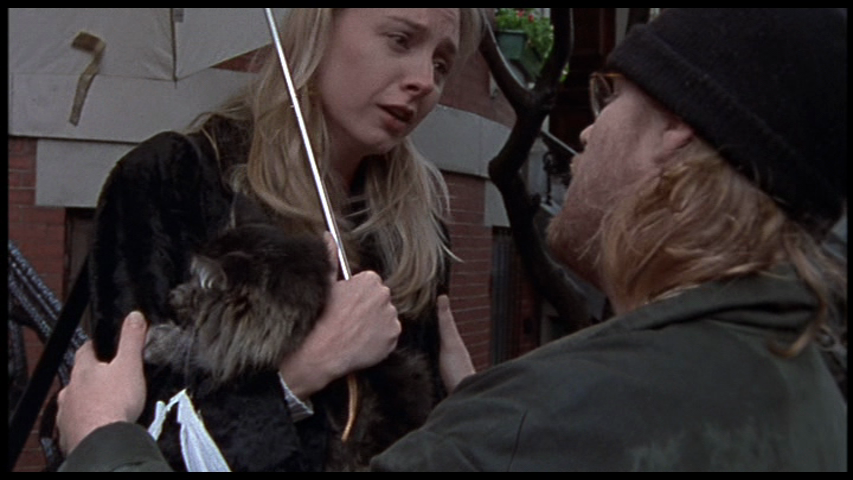
Next Stop, Wonderland was Hope Davis’ one great moment. True, she was great in Day Trippers, which was another cute film from the indie renaissance, but that was an ensemble piece and has not aged particularly well. She was also in the fabulous Myth of Fingerprints, but only in a small supporting role that didn’t really give her much to do. But here in Next Stop, Wonderland that combination of latent electricity bubbling under a dominant melancholy that she has going in spades gets a chance to fully dazzle us, as does her easy, subtle range as an actress (which is decidedly less evident now since she started to be unimaginatively typecast by Holywood in the last decade.) She plays the lonely and loveless Erin with soul, humor, and a quiet dignity that combines in a very convincing and appealing performance. It’s a shame she didn’t get the chance to take the lead in more films.

Davis plays opposite Adam Gelfant, who plays a down-to-earth, hard working guy trying against the odds to make something of his life. Gelfant is a very interesting actor because he looks and sounds so much like a real person – this is probably why he’s never in anything! He may be the most unusual and seemingly inappropriate romantic lead I’ve ever seen in a film, excluding films that are purposely trying to be outrageous. Gelfant’s refreshing and unassuming presence and performance have really grown on me over the years. They contribute to making the film uniquely wonderful. If only modern filmmakers would more often exhibit this kind of guts when casting their films!

Next Stop Wonderland flows forward in a very pleasing and engaging way. The transitions from scene to scene are downright elegant, and the emotional quality of each scene is solid and moving. It has a score (modern solo piano) that is somehow perfect but at the same time unexpected and a bit incongruousness with the material – I’m not sure why it works so well, but it does. The film’s humor is the very opposite of ponderous and heavy handed – it is so light and sure-footed that if you blink you might totally miss it. All of these attributes tend to show up in films from the indie renaissance, but Next Stop Wonderland may be the purest example of how they could all come together. It is so smooth and easy to watch, you almost forget to register the broad array of emotions and elements of the human experience that the film is dealing with.

There is a strange beauty about this little film. The way the two leads’ lives keep intersecting and their semi-conscious awareness of this. The sadness of Hope Davis’ character and her clearly tormented feelings toward her pathetic boyfriend, played exquisitely by Phillip Seymore Hoffman. (The scene where he returns to her is a beautifully acted scene.) The way the Emerson quotation weaves its humorous way through the film, only to blossom unexpectedly at the end of the film. The strange seductiveness of the Brazilian guy, and the way he starts to melt Hope Davis’ icy exterior. The fatalistic implications of the film’s name, and how they resolve. And all done in the context of what is essentially a light romantic comedy. Lovely stuff, really.

Don’t miss out on this little gem from the glorious indie renaissance. Netflix it and enjoy a breath of fresh air!

Posted in Appreciations (Irreviews Favorites), Films of the 1990s | Comments Off on Next Stop, Wonderland (1996): An Appreciation

Fair Game – The Best Film of the Year

Not only is Fair Game far and away the best film of the year, it is without question destined to be a timeless classic. My wife and I were in complete agreement about its fabulousness, and we discussed the film’s many remarkable qualities for hours afterward. It’s that good!

This film is so efficient that it feels like you watched a totally riveting 3 hour film in 2 hours flat. The amount of fascinating detail that is so skillfully and effortlessly crammed into this film is incredible. The film is completely unrushed in its setup, and I’m having trouble thinking of another film that manages to simultaneously set up so many different story lines without getting bogged down and killing the momentum of the film. The film’s dialog is superb, scene structure is sophisticated and rich, the lead actors are both amazing in their roles, and the supporting casting and acting is excellent down to last.

The basic story is (or should be) well-known: evil Republicans destroyed the career and life of a valuable CIA operative and got scores of innocent people killed just because in their warped view of democracy the President can’t ever be allowed to look bad. But the film also explores in an extremely satisfying way the inner workings of the CIA (both the spectrum of attitudes among its employees and the details of how CIA projects proceed), the psycho-emotional bond Plame had to the CIA, and the gutter mentality of the major media. It also explores the effect Plame’s outing had on her life and on her relationships with her family and friends without ever descending into hysterical “why didn’t you tell me?” rants from her friends, or smarmy, cringe-inducing scenes with the kids. Everything the film tackles it tackles with the utmost dignity and deftness.

Just to pull out a few select moments for additional praise:

Fair Game makes the whole “yellow cake uranium” thing much more interesting than it ever seemed at the time. I’d even go as far to say that it makes it way more interesting than it actually is. Joe Wilson’s initial fact-finding trip that he undertakes for the CIA is just a beautifully done sequence, a classic example of how a skillful set up can propel a movie far beyond the actual content of the set up. I mean, the basic message of the sequence is simply “they didn’t sell yellow cake to Iraq.” But the way it’s done does so much for the narrative energy of the film – modern filmmakers would be wise to study this little sequence, and emulate its techniques.

The scene between Scooter Libby and the CIA supervisor guy (played by Tim Griffin) is an absolute masterpiece. The way they captured how Libby is so intent on twisting what his interviewers are saying that he actually trips over his own ideas as he is talking … well, all I can say is that I don’t think I’ve ever seen this kind of behavior captured this well in film. Truly a classic scene!

So many little scenes are just perfectly gauged, like the scene where the civilian operative (who infiltrates Iraq for Plame) asks her brother about the Iraq’s weapons development program and the infamous WMD’s. There are so many ways this film could have chosen to communicate to the viewer the fact that Iraq’s weapons program (the moral foundation of our invasion and occupation) was completely destroyed by us after the first Gulf War, but what makes Fair Game so great is that it picks a way that does not make it boring, trivialize it, or create a throw-away scene that kills momentum. Instead, the discussion between these two, hiding out in the garden, away from other family, winds up being the most thrilling way for us to learn that information. I can’t say enough about how this film gets these little choices perfectly right, time and again.

I’d also like to take a moment to appreciate how the film managed to convey effectively (as a tiny subplot) the sense of how it must feel to the peoples of other nations to be viciously bombed by us, the United States. This is something that you don’t see in films very much, and using very little on-screen time they manage nevertheless to do it beautifully and compellingly. We as Americans have no conception of how this must feel to them because we rule the entire world so completely and with such almighty power that there is nothing anyone can do about our military actions. Think about it: who were the innocent civilians of Iraq going to complain to? The UN? We are the UN! If the whole rest of the UN condemns an action that we support, it’s as if they didn’t condemn it at all (Israel’s actions against the Palestinians over the last several decades is the most blatant example of this.) So basically they just have to sit there and get bombed, and wait until we get bored of bombing them or it gets too expensive to continue bombing them, at which point they can (if we don’t then starve them to death with sanctions) try to pick up what little is left of their lives. It’s just nice to see a busy film like this one taking the time to expose Americans to a little of the truth they never see and never think about. Bravo!

Let’s talk about the performances. Naomi Watts has never been a favorite of mine, far from it in fact. But she gives a terrific performance as Valery Plame, simultaneously capturing the complex character of her loyalty to the CIA (in particular, her ridged and dogged integrity) and the equally complex character of her personal life and relationships. Plus, she looks a lot like Valerie Plame. She is completely convincing. In the other lead role, Sean Penn proves again that he is the greatest actor of his generation, and it’s not even close. Penn has no tics – he disappears into roles with marvelous skill. His performance in this film is off-the-charts fabulous! I thought Milk was a great performance, and it was, but this roll is in a way even more impressive, because it is less flashy but he somehow makes it equally memorable.

The only criticism of this film, and it’s a very minor one, is that I found it hard to read the text at the end at the same time as listening to and watching the actual Senate testimony of the real Plame. I would have flashed the text first, and then showed the footage over the credits only. I also might have shown more of the testimony, because by the time you finally get to that moment, you really want to hear her say everything she came to say.

Fair Game is a must-see, as far as I’m concerned. And whatever movie the Academy picks for 2010 best film, if it’s not Fair Game they made the wrong choice.

Posted in 2010 | Tagged , , | Comments Off on Fair Game – The Best Film of the Year