
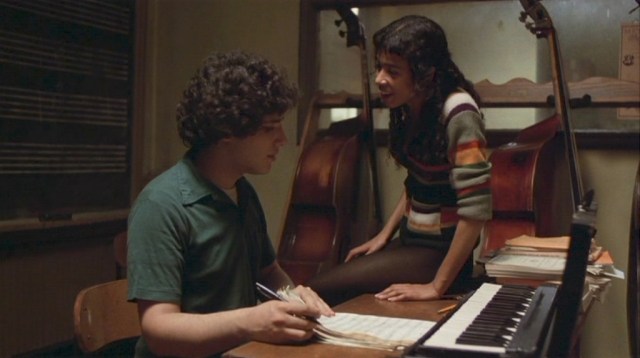
 The original Fame: It was perfect, so why would anyone remake it?
Alan Parker’s Fame (1980) is a landmark film. It stands with other timeless, near-perfect classics such as Missing, The Verdict, Tootsie, and My Dinner with Andre at the very end of the golden age of cinema, right before film making started to go south around the mid 80’s. Although dismissed at the time as being equivalent to concurrent rubbish like Flashdance, time proved the critics wrong and watching the film now the breadth and depth of its artistic quality is shocking to behold. In its own way, Fame is an absolute masterpiece, the kind of masterpiece that I doubt could ever be approached by modern films, let alone equaled or surpassed.
So now, on the 30th anniversary of this remarkable film we are given the opportunity to compare it to modern films in the most direct and painful way imaginable: someone actually re-made Fame.
Why would anyone ever remake Fame? It is almost impossible to compete with its overall artistic vision. The way is captures the gritty coolness of 1970’s New York. The stunning approach to editing and scene structure. The beautiful screenplay and its dazzling range of emotion. The marvelous casting and impeccable naturalistic performances from complete no-name actors. The incredible developmental arcs of the main characters. And of course the fabulous original music performed by the actors themselves, songs that still do not sound dated and which are every bit as beautiful and moving 30 years later.
Given my obvious fondness for the original movie, I was expecting the worst when my wife and I walked into Fame 2009 on opening night in New York City. I should have known something was up when representatives from the studio were outside the theater passing out survey cards to us in a desperate attempt to figure out how to market this film. But I must admit, no amount of initial cynicism could have prepared me for what was in store for me.
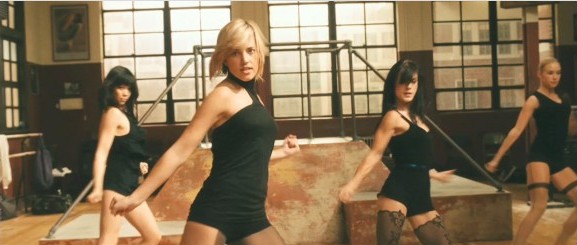 The new Fame: cold, heartless, stylized crap
It is not just that the new Fame is an awful film. It’s unquestionably awful – this film makes Raise Your Voice look like one of the greatest films of all time. But it’s deeper than that. Comparing the old and new Fame actually reveals a huge cultural shift that has taken place in the intervening time.
A couple hours after suffering through this film, my wife pointed out this deep shift underlying the weird disoriented feeling that comes from watching the new Fame: How could they make a film called “fame” and have none of the characters ever talk about wanting to be famous, or what it meant to them? How could we sit in the film for two hours without noticing this? How could the critics watch this film and not even register this fundamental disconnect? I mean, it’s glaringly obvious. They spend all this time in the beginning showing a set of stage lights spelling out the key word, “fame,” and then no one in the film is driven at all, or seems to give a shit. You have no idea why these kids are even there in that school, except for a couple of them who were forced in by their parents.
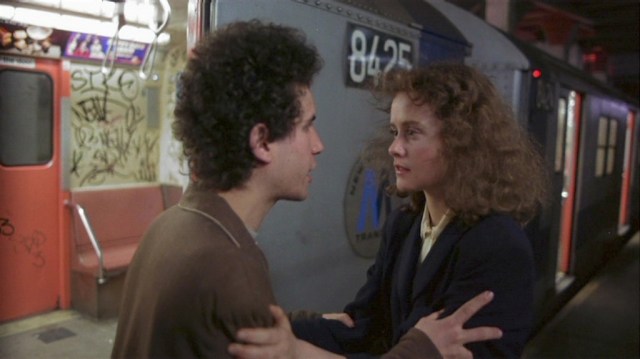 Passion and dreams: Ralph and Doris from the original Fame.
In the original Fame, those kids really wanted to be famous, and to leave an artistic mark of some kind. Or they at least had a philosophical attitude toward the concept of fame and their likelihood to achieve it. And they talked about it … a lot! They were passionate, driven, naive perhaps, but independent and bold nonetheless. Even Bruno wanted to be famous – he just didn’t care if it happened in his lifetime, but he wanted it! The closest this new film comes to the topic is when some kid on stage delivers the incredibly hackneyed line “success is love.” In the original, it was written into every word and action of the characters; you felt their passion and love in everything they said, thought, and did! And this includes their obvious passion for the school itself and what they were getting from it!
Not these kids in the new Fame! Let’s run through a role call of these freaks, shall we?
The rapper dude, Malik, was in the acting division. Why? He showed no interest in being an actor at all. You never see him acting, or talking about acting. He showed no interest in school at all. All he wanted to do was be a rapper and get out of the ghetto. And he sucked as a rapper on top of it all. Malik is supposed to be part “Leroy” and part “Ralph” from the original Fame. But Leroy (who didn’t even have a home) loved dancing and loved the artistic part of the school. Gene Anthony Ray, who played Leroy, didn’t have many lines, but he was a great physical actor, and managed to get across his warmth, passion and determination, along with his resentment and anger. This guy Malik is just all anger. He doesn’t even seem upset as he recalls his little sister getting killed, not anymore than the Terminator was upset when people died. Compare his reaction to the incredible scene in the original where Ralph finally talks about his “other sister” and reveals his role in what happened to her – it’s a devastatingly sad scene. Malik is completely incapable of any emotion except anger. He’s downright frightening. Sometimes he seems like all he really wants to do is kill people.
Next, that kid Marco didn’t seem traumatized at all that he spent his entire childhood singing in his parent’s Italian restaurant. That’s the kind of shit you wind up in therapy over. That kid didn’t even have a pulse! He didn’t even seem to enjoy performing, or even want to perform. People driven to perform, they LOVE performing! All this guy has to say for himself as an actor is “I’m just happy to be here, man.” He didn’t even seem that jazzed at having the cutest girl in the school as his girl friend.
The “Bruno” character, Victor: He has no respect for music, its history, nothing. He shows no interest in school either – it’s like he and Malik don’t even go there. You certainly never see him learning anything! And his own compositions were utter tripe – my jaw dropped off when Kelsey Grammer listens to his middle school synthesizer drivel in the audition and then says “you got talent, son!” Good God! Compare this to the original Bruno. Compare Victor’s crap music to the stuff Bruno was writing. And Bruno actually respected the school and classical music – he just felt Mozart would not have bothered with a orchestra nowadays, and maybe he was right, who knows?
 The new “Bruno” and “Montgomery”: bloodless drones
I should add that it’s really hard to believe that Victor was in love with the dancer chick Alice because they never even have a conversation. You just see him lusting after her body. In the original Fame, yeah Leroy is not much of a talker, but Hillary van Doren (played exquisitely by Antonia Franceschi) is a fascinating character, and her relationship to Leroy is a great story. In the final scene between Victor and Alice it’s really obvious that he had no idea she was in fact a completely shallow bitch, which he finds out when she dumps him after years like she doesn’t even know him, simply because they are graduating. That’s how “well” he got to know her. And it is completely unclear why she goes for him anyway – he’s far from the best looking guy in the school.
Let’s talk about this dancer chick for a second. Apparently she is a fully formed world class dancer who like the rest of them is bored out of her mind in the school. She doesn’t even seem to like dancing very much. She doesn’t seem to like anything. You don’t even see her taking any classes. Maybe she is exempt from them since she is already the greatest dancer in the world, I don’t know. Why is she even in the school? She is just pissing four years of her life away there until God delivers her ordained spot in some big modern dance company. Compare this to the passion of Hillary van Doren, who had a dream of dancing all the classical roles before she was 20, and clearly loved dancing, loved working on her dancing dream, and was totally broken up when events transpire to threaten that dream!
 Hillary van Doran and Leroy, from the original Fame
Then there’s the singer, Denise. She also comes into the school fully formed, as a world class pianist – it’s totally unclear that the school has anything to teach her, she looks so bored. Her parents can clearly afford a real conservatory, yet there she is in that hole. She is also supposedly a shut-in who never got to do anything she wanted. But it is then revealed that she is also secretly a fully formed world-class R&B singer! Yeah right – in what universe does that happen? What should have happened is this: she gets to the school, hears some R&B singing, tries it herself and likes it, practices that style of singing, gets pretty good, then Victor discovers her practicing, they blend it in with his hip hop stuff … THAT is a story line of self-discovery. People who spend their lives NOT singing do not suddenly have killer pipes like that babe! The voice is a muscle, like any other – it has to be trained, formally or informally. What on earth were these writers thinking?
At the end of the film I still had no idea what the names of most of the lead characters were. I had to look them up on IMDB for this review, which tells you something about the quality of the writing and the depth of the story. The one exception is “Jenny,” and I only remembered her because the actress playing her (Kay Panabaker) has to be the worst actress in a major role I’ve seen in years. All of a sudden Alexis Beldel is not looking so bad in Post Grad! The audience near us was openly laughing in Panabaker’s scenes. She is simply awful, and her character is just an intolerable little twerp. Put the two together and every appearance of Jenny on the screen was enough to make you wince in pain. In one of her more excruciating scenes, I actually heard someone near me in the audience say to a friend “I wanna pull all her hair out!”
Anna Maria Perez de Tagle, who plays the girl who leaves for a role on Sesame Street, gives the best performance in the film, but her character Joy is not major at all. Joy embodies the aspect of Ralph that his career got going before he leaves PA. But Ralph graduated. This chick, she’s hauled in and told she is flunking out and she clearly doesn’t give a fuck, saying “well, the show is busy, I can’t help it.” So much for the magic of PA.
The bottom line is that all these kids are postmodern walking dead. They already know everything, and they’re bored out of their fucking minds. The school can do nothing for them, in fact, the school is clearly inconveniencing them. They have no desires, no emotions, no real dreams, no semblance of humanness. They’re lobotomized freaks. They don’t even have a sex drive! They’re like characters in a Mad Max film – they know there’s no point!
Think about how ALIVE the characters were in the original Fame. Think about the sex! These films are about teenagers, after all. Leroy knocks up Hillary. Doris is lusting for Boyde Gains the whole first year. Montgomery is secretly dying of love for Ralph, in one of the most beautiful and subtle portraits of unrequited love I have ever seen. Ralph and Doris get it on, big time! And how about all the guys cramming around the peep-hole into the girls locker room? This is how teenagers behave! But these new Fame teens are beyond all that. They’re like pod people, bred in laboratories.
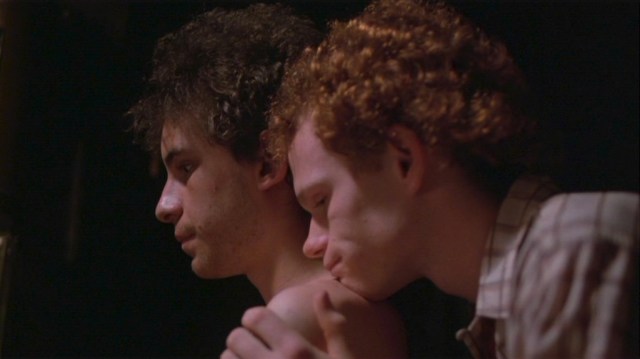
Unrequited love: Ralph and Montgomery from the original Fame.
I think it’s fascinating that they felt the need to cut the second verse of “Out Here On My Own” (forced in from the original film) figuring that modern audiences could never sit through a song THAT good, for THAT long! But what’s even more fascinating is how inappropriate that song suddenly is in this new version of the film. Coco’s performance of that song is one of the great musical moments in film history, and it works because although Coco was a bold, confident, and super motivated character, she had a soft underbelly that was revealed through subtext in Irene Cara’s marvelous performance. But these modern kids don’t have soft underbellies! They are adamantine drones, half-man half-machine, flown in from an off-world colony. They should have had scenes of them climbing skyscrapers with their bare hands. The replicants in Blade Runner had much greater emotional range than any of these zombie children. Thus the song makes no sense – these kids aren’t afraid of anything. They feel nothing!
Then there is the finale. I’ll just say it: the song is the worst of its kind I’ve ever seen. The lyrics are so awful I can’t actually think of a apt comparison from the realm of professional songwriting. You have to look to amateur songwriting, something like a “we can be great” song written by a self-help cult leader that cult participants sing hand-in-hand at “graduation.” It’s that bad. Then, all these people in bird suits come out and start pounding conga drums … forget it, I can’t even begin to capture the absurdity of this scene, other than to say that my wife and I were openly laughing our asses off at what was supposed to be the climatic moment in the film.
There was a time when films were filled with honest human emotion, regardless of genera, and which explored that emotion through the timeless art of plotting and dialog. Think back … Fame, An Unmarried Woman, Missing, The Conversation, Alice Doesn’t Live Here Anymore, What Happened Was …, The Changeling, Klute, Running on Empty, Ruby in Paradise, whatever. Sure, you still see it occasionally (Tumbleweeds, for example) but it is now the exception that proves the rule.
What is happening in this society? Why is the art we relate to so cold and inhuman now, and so focused on our isolation, existential despair and predestined doom? I have a lot of theories on the matter. But what I will say here is that comparing the old Fame to the new is a really depressing experience, and the reason for this is that the difference between the two films reflects what’s being lost … our humanity.
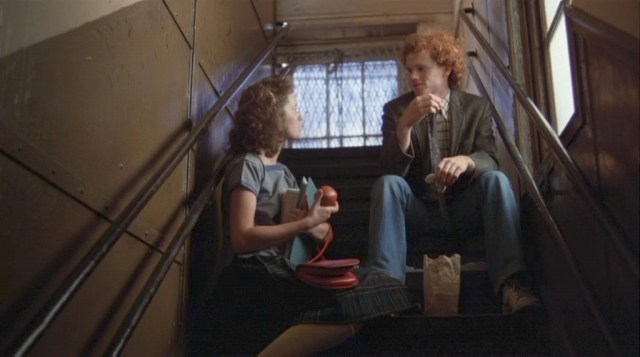 The original Fame: even the smallest scenes are unforgettable
 Irreviews